
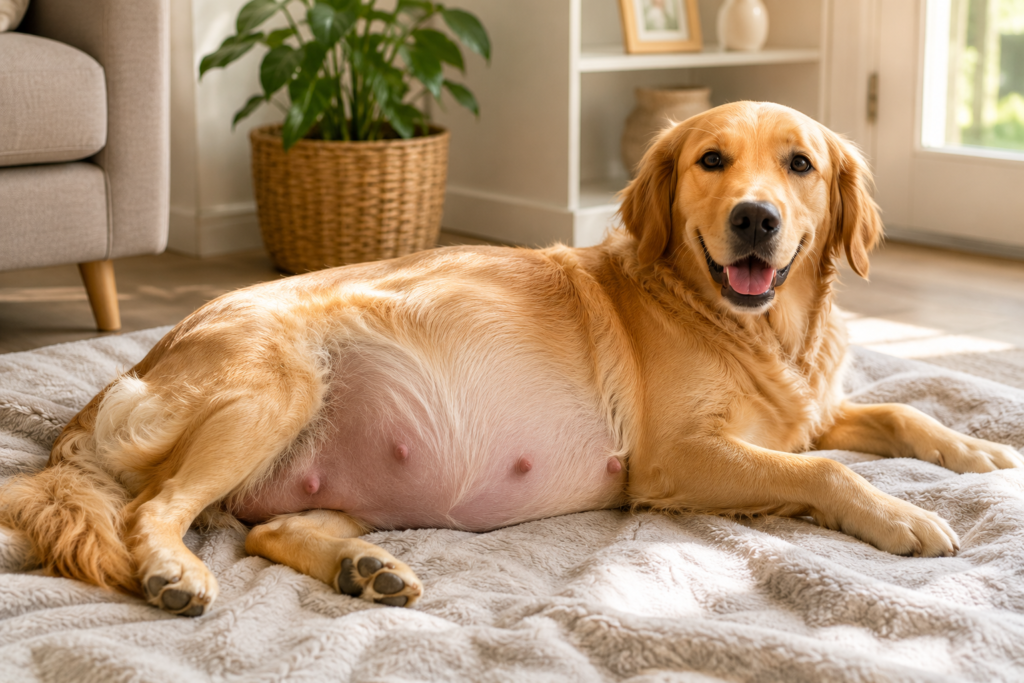
Quick Answer: Dogs are pregnant for an average of 63 days (about 9 weeks) from the time of ovulation, with most pregnancies lasting 58 to 68 days. If you’re counting from the first mating instead of ovulation, pregnancy may appear to last 57 to 72 days because sperm can survive inside the female reproductive tract for up to 10–11 days before fertilization occurs.
If your dog’s pregnancy extends beyond the expected due date, or she shows signs of distress, prolonged labor, or abnormal discharge, contact your veterinarian immediately.
Pregnancy Timeline at a Glance
| Pregnancy Stage | What to Expect |
|---|---|
| Weeks 1–2 | Fertilization occurs. No visible signs. |
| Weeks 3–4 | Pinker nipples, mild appetite changes, pregnancy can be confirmed by ultrasound around day 28–30. |
| Weeks 5–6 | Belly enlarges, puppies grow rapidly, switch to puppy food. |
| Weeks 7–8 | Puppy movement may be felt, nesting behavior begins, prepare the whelping box. |
| Week 9 | Temperature drops before labor, puppies are ready to be born. |
Key Takeaways
- A typical dog pregnancy lasts about 63 days (9 weeks), with 58–68 days considered normal.
- Pregnancy length appears longer when counted from the breeding date because fertilization may occur several days later.
- Small breeds often give birth slightly earlier, while large and giant breeds may carry puppies a few days longer.
- Pregnancy can usually be confirmed by ultrasound around day 28–30 or by X-ray after day 45.
- Feed a high-quality puppy food during the last 3–4 weeks of pregnancy to support rapid fetal growth.
- Puppies can often be felt moving around weeks 6–7.
- Watch for emergency warning signs such as dark green discharge before labor, prolonged straining without a puppy, or more than two hours between puppies.
- Regular veterinary checkups are the safest way to monitor both the mother and her developing puppies.
Learning that your dog is expecting puppies is exciting, but it’s also natural to wonder what happens next. Understanding how long dogs stay pregnant, what changes to expect each week, and when to seek veterinary care can help you prepare for a safe pregnancy and delivery.
Most healthy dogs are pregnant for about 63 days, although the exact due date varies depending on when ovulation occurred, the breed, litter size, and individual differences. Throughout those nine weeks, your dog will experience noticeable physical and behavioral changes as her puppies grow and develop.
In this guide, you’ll learn how long a dog pregnancy lasts, the week-by-week milestones, early signs of pregnancy, nutritional needs, labor preparation, emergency warning signs, and answers to the most common questions owners ask.
Can You Tell If a Dog Is Pregnant at Home?
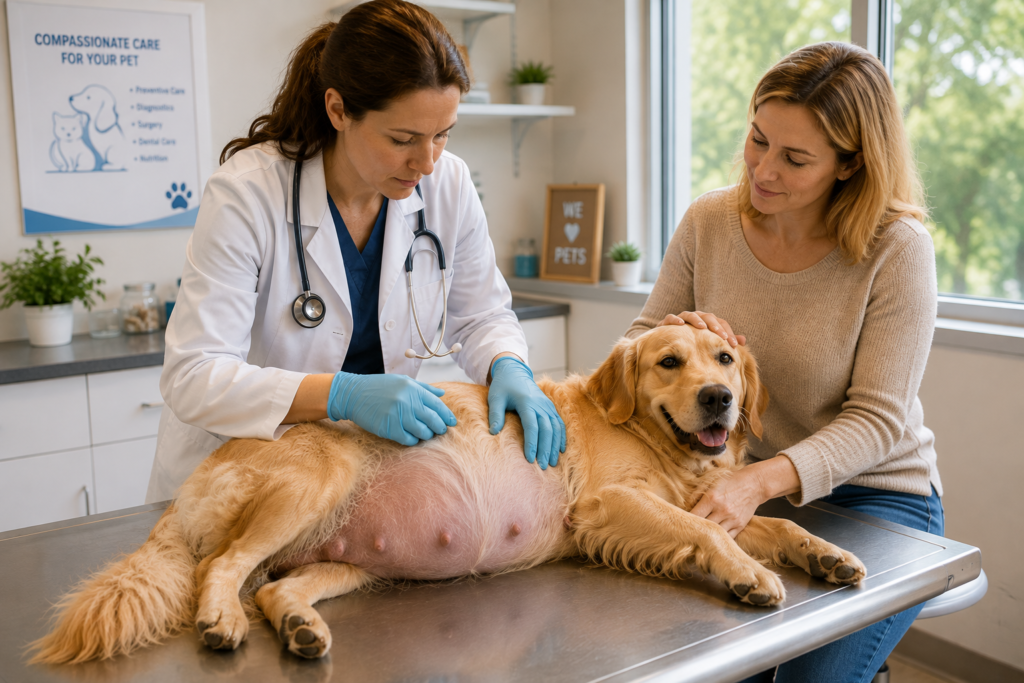
While some early pregnancy signs can be noticed at home, it’s difficult to confirm pregnancy without veterinary testing. During the first few weeks, many pregnant dogs show only subtle changes that can easily be mistaken for a normal heat cycle or even a false pregnancy.
Common signs you may notice at home include:
- Enlarged or pinker nipples
- Mild decrease in appetite
- Increased sleepiness or lower energy levels
- Becoming more affectionate or seeking more privacy
- Gradual weight gain after the fourth week
- Enlarging abdomen during the second half of pregnancy
- Nesting behavior as the due date approaches
Although these signs can suggest pregnancy, they aren’t definitive. Conditions such as pseudopregnancy (false pregnancy) can produce nearly identical symptoms.
The most reliable way to confirm pregnancy is through your veterinarian. Ultrasound can usually detect puppies around day 28–30, while X-rays performed after day 45 provide the most accurate estimate of litter size.
Practical takeaway: If you suspect your dog is pregnant, schedule a veterinary examination rather than relying on physical signs alone.
Dog Pregnancy Week by Week
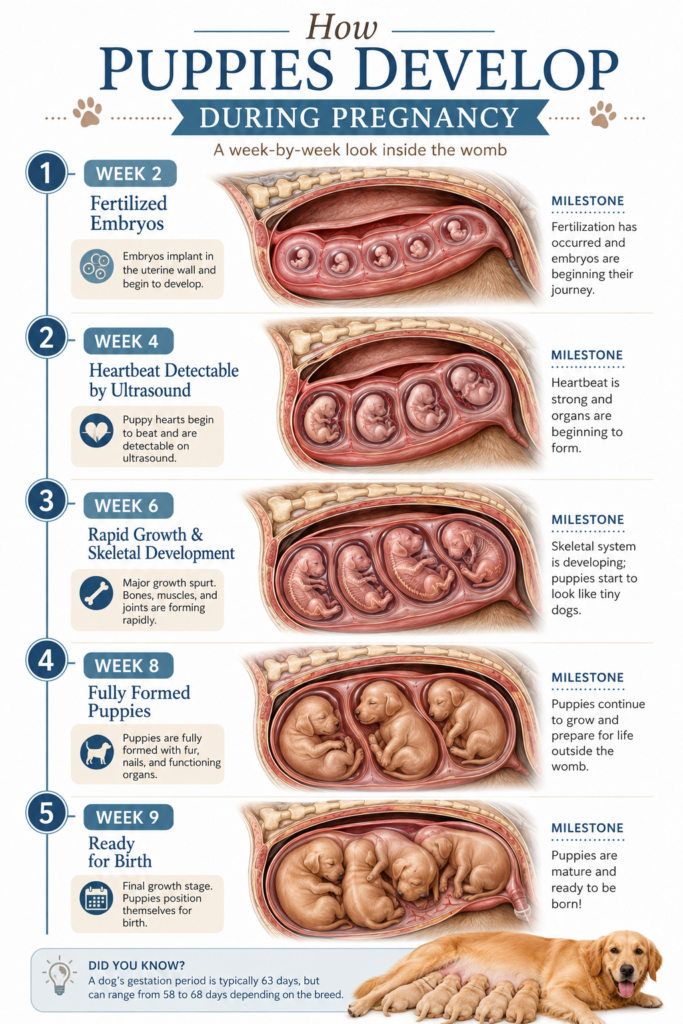
Knowing what happens each week helps you monitor your dog’s health and prepare for the arrival of her puppies.
Weeks 1–2 (Days 0–14)
- Fertilization occurs after ovulation.
- Embryos begin traveling toward the uterus.
- Most dogs show no visible pregnancy signs.
- Continue feeding a normal, balanced diet.
- Maintain regular exercise unless your veterinarian advises otherwise.
Weeks 3–4 (Days 15–28)
- Embryos implant into the uterine wall.
- Nipples may become larger and pinker.
- Mild nausea or temporary appetite loss may occur.
- Ultrasound can usually confirm pregnancy around day 28–30.
Weeks 5–6 (Days 29–42)
- Puppies grow rapidly.
- Belly enlargement becomes noticeable.
- Weight gain increases.
- Begin gradually switching to a high-quality puppy food.
- Feed smaller meals more frequently as space in the abdomen decreases.
Weeks 7–8 (Days 43–56)
- Puppies develop fur and stronger skeletons.
- Puppy movement may be felt.
- Mammary glands enlarge.
- Prepare the whelping box and gather supplies.
Week 9 (Days 57–63)
- Puppies are fully developed.
- Nesting behavior becomes more obvious.
- Appetite often decreases shortly before labor.
- Body temperature typically drops below 100°F (37.8°C) within 12–24 hours before labor begins.
Practical takeaway: Begin monitoring your dog’s temperature twice daily from day 58 so you’ll recognize when labor is approaching.
What Happens During the Middle of Pregnancy?
Around the halfway point of pregnancy, your dog’s physical changes become much more noticeable. Her abdomen begins to enlarge, weight gain accelerates, and the growing puppies become increasingly active.
By weeks 6–7, many owners can gently feel puppies moving while the mother is resting on her side. These movements are reassuring but shouldn’t be used to estimate litter size, as some puppies may be sleeping while others move repeatedly.
If you want to know approximately how many puppies to expect, your veterinarian will usually recommend an X-ray between days 45 and 55. At this stage, the puppies’ skeletons have developed enough to be counted accurately.
Litter size varies greatly depending on breed and genetics:
| Breed Size | Average Litter Size |
|---|---|
| Small breeds | 1–4 puppies |
| Medium breeds | 4–8 puppies |
| Large breeds | 8–12 puppies |
| Giant breeds | 10+ puppies (varies) |
Practical takeaway: Don’t judge litter size by your dog’s belly. An X-ray in the final weeks provides the most reliable estimate.
What Should I Feed a Pregnant Dog?
During the first half of pregnancy, most dogs can continue eating their normal high-quality adult food. Nutritional demands increase rapidly during the final four weeks as the puppies experience their fastest period of growth.
Veterinarians generally recommend transitioning to a complete and balanced puppy formula around weeks 5–6, as it provides additional calories, protein, and essential nutrients needed during late pregnancy.
To support your dog’s changing nutritional needs:
- Transition gradually to puppy food over 5–7 days.
- Feed smaller meals more often.
- Always provide fresh drinking water.
- Avoid calcium supplements unless specifically recommended by your veterinarian.
- Expect food intake to increase during the final weeks of pregnancy.
Practical takeaway: A high-quality puppy food usually provides everything a healthy pregnant dog needs without additional supplements.
Preparing for Whelping (Giving Birth)
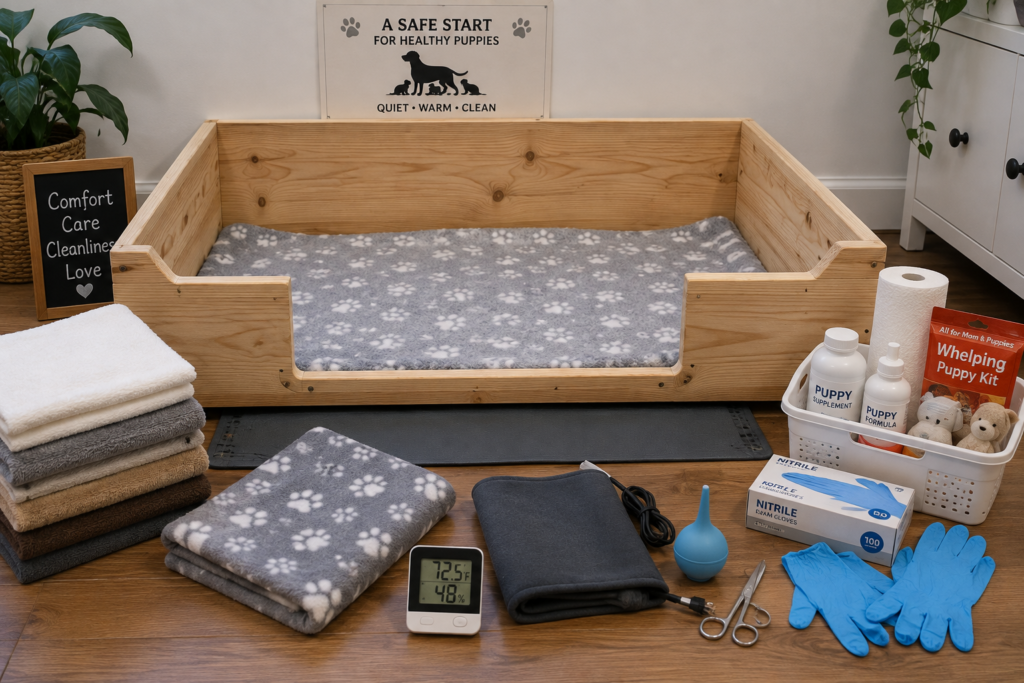
Preparing ahead of time makes labor much less stressful for both you and your dog. Ideally, everything should be ready by week 7, giving your dog plenty of time to become comfortable with her whelping area.
Your whelping box should:
- Be large enough for your dog to stretch out comfortably.
- Have low sides that the mother can step over easily.
- Be placed in a warm, quiet, draft-free room.
- Contain clean, washable bedding.
- Include pig rails to help prevent puppies from being accidentally crushed.
Your whelping kit should include:
- Clean towels
- Whelping pads
- Blunt-tipped scissors
- Dental floss or sterile cord ties
- Antiseptic solution for umbilical cords
- Bulb syringe
- Digital thermometer
- Your veterinarian’s emergency phone number
Starting around day 58, begin taking your dog’s rectal temperature twice daily. A drop below 100°F (37.8°C) usually indicates that labor will begin within the next 12–24 hours.
Practical takeaway: Having your supplies ready before labor begins allows you to focus entirely on supporting your dog when the puppies arrive.
How to Know When Your Dog Is About to Go Into Labor
As your dog’s due date approaches, several physical and behavioral changes signal that labor is near. The most reliable indicator is a drop in body temperature below 100°F (37.8°C), which typically occurs 12–24 hours before labor begins.
Other common signs include:
- Restlessness or pacing
- Nesting behavior
- Panting or shivering
- Loss of appetite
- Seeking a quiet place
- Increased licking of the vulva
Labor occurs in three stages:
Stage 1: Early Labor
The cervix begins to dilate while your dog becomes restless, pants, nests, or may even vomit. This stage usually lasts 6–12 hours, although some dogs take longer.
Stage 2: Active Labor
Strong abdominal contractions begin, and the first puppy is usually delivered within 1–2 hours of active pushing. Puppies may be born head-first or breech; both presentations are considered normal.
Stage 3: Placenta Delivery
Each puppy is normally followed by its placenta. Most mothers instinctively chew the umbilical cord and may eat the placenta after delivery.
Practical takeaway: Once your dog’s temperature drops below 100°F (37.8°C), monitor her closely, as labor is likely to begin within the next 24 hours.
🚨 When Should You Call Your Vet?
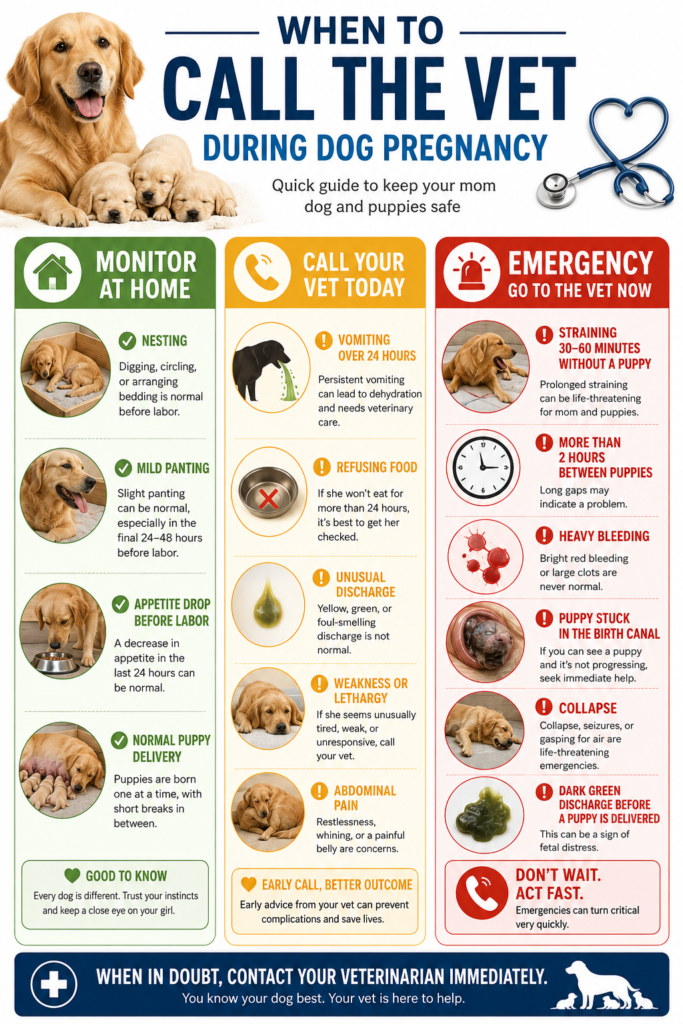
While most dog pregnancies progress without complications, certain warning signs require immediate veterinary attention.
Call Your Veterinarian Today If Your Dog:
- Has persistent vomiting lasting more than 24 hours
- Refuses food and water for over 24 hours (outside the normal pre-labor period)
- Becomes extremely lethargic or weak
- Develops a painful or suddenly swollen abdomen
- Has green, yellow, brown, or foul-smelling discharge before labor begins
Seek Emergency Veterinary Care Immediately If:
- Your dog strains for 30–60 minutes without delivering a puppy
- More than 2 hours pass between puppies with no progress
- Heavy bright-red bleeding occurs
- A puppy becomes stuck in the birth canal
- Your dog collapses or appears to be in severe distress
- Dark green or black discharge appears without a puppy being delivered within 30 minutes
Practical takeaway: If you’re unsure whether labor is progressing normally, it’s always safer to contact your veterinarian than to wait.
Pregnant Dog Not Eating: Is It Normal?
A temporary loss of appetite can occur during pregnancy and isn’t always a cause for concern. Many dogs eat less around week 3, when hormonal changes may cause mild nausea, and again during the 24–48 hours before labor, when whelping is about to begin.
However, complete refusal to eat for more than 24 hours outside these expected periods should never be ignored.
To encourage eating:
- Offer smaller meals more frequently.
- Warm the food slightly to improve aroma.
- Mix in a small amount of plain boiled chicken if recommended by your veterinarian.
- Ensure fresh water is always available.
Practical takeaway: Brief appetite changes are normal, but prolonged refusal to eat or drink deserves prompt veterinary attention.
False Pregnancy in Dogs
False pregnancy, also called pseudopregnancy, occurs when an unspayed female dog develops pregnancy-like symptoms despite not carrying puppies. Hormonal changes after a heat cycle can closely mimic those of a true pregnancy.
Common signs include:
- Enlarged mammary glands
- Milk production
- Nesting behavior
- Carrying toys as if they were puppies
- Changes in appetite
- Increased clinginess or protective behavior
Most false pregnancies resolve naturally within 2–3 weeks without treatment. However, if symptoms are severe or occur repeatedly, your veterinarian may recommend treatment or discuss the benefits of spaying.
Practical takeaway: Because false pregnancy closely resembles a real pregnancy, veterinary confirmation is the only reliable way to know whether your dog is expecting puppies.
Common Pregnancy Complications in Dogs
Although most pregnancies are uncomplicated, it’s important to recognize problems that require immediate veterinary care.
Potential complications include:
- Dystocia (difficult labor): Puppies cannot be delivered normally and may require a Caesarean section.
- Pregnancy toxemia: A serious metabolic condition caused by inadequate nutrition during late pregnancy.
- Eclampsia (low blood calcium): Usually develops shortly after birth but may begin during late pregnancy, causing tremors, weakness, and seizures.
- Miscarriage or fetal loss: May occur because of infection, trauma, or underlying medical conditions.
- Uterine infection: Can cause fever, abnormal discharge, lethargy, and loss of appetite.
Early veterinary care greatly improves outcomes for both the mother and her puppies.
Practical takeaway: Regular prenatal veterinary visits are the best way to detect complications before they become emergencies.
FAQ
How long is a dog pregnant after mating?
If you’re counting from the first mating, pregnancy may appear to last 57–72 days because fertilization doesn’t always happen immediately. Sperm can survive inside the female reproductive tract for up to 10–11 days before the eggs are fertilized. If the ovulation date is known, most dogs give birth about 63 days later.
Can a dog be pregnant for 70 days?
Yes, especially if you’re counting from the first breeding rather than ovulation. However, if your dog has gone beyond the expected due date or shows no signs of labor, contact your veterinarian for an examination.
Can dogs get morning sickness?
Yes. Some pregnant dogs experience mild nausea or occasional vomiting during weeks 3–4 of pregnancy because of hormonal changes. These symptoms are usually short-lived. Persistent vomiting, however, is not normal and should be evaluated by a veterinarian.
How accurate is a dog pregnancy calculator?
A pregnancy calculator provides an estimate based on the breeding or ovulation date. Calculators using the ovulation date are generally more accurate than those using the first mating date because fertilization may occur several days after breeding.
Can you use a human pregnancy test on a dog?
No. Human pregnancy tests detect the hormone hCG, which dogs do not produce during pregnancy. Veterinarians instead use ultrasound or a relaxin blood test, which can usually confirm pregnancy from around day 28.
How many times can a dog safely become pregnant?
The safest number varies depending on your dog’s breed, age, and overall health. Responsible breeders allow adequate recovery between litters and avoid breeding older dogs or those with health problems. Your veterinarian can advise whether another pregnancy is safe for your individual dog.
Is discharge normal during dog pregnancy?
A small amount of clear or mucus-like discharge may be normal. However, green, yellow, brown, black, bloody, or foul-smelling discharge before labor should always be treated as an emergency and evaluated by a veterinarian immediately.
Conclusion
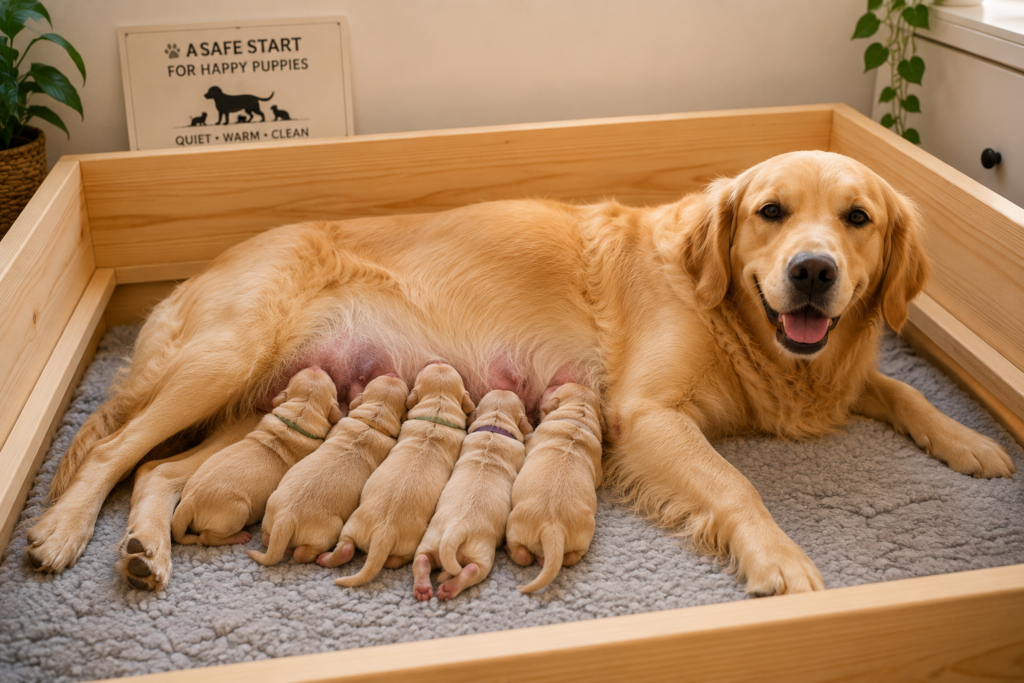
A typical dog pregnancy lasts about 63 days, although the exact length depends on when fertilization occurs and the individual dog. Understanding the week-by-week changes, providing proper nutrition, preparing a safe whelping area, and recognizing emergency warning signs can help both the mother and her puppies stay healthy.
Regular veterinary checkups throughout pregnancy are the best way to monitor your dog’s progress and prepare for a safe delivery. If you notice unusual discharge, prolonged labor, or signs of illness at any stage of pregnancy, contact your veterinarian immediately. With good preparation and timely veterinary care, you’ll be ready to welcome a healthy litter of puppies into the world.
References
[1] Dog Pregnancy Stages – https://www.webvet.com/dog-pregnancy-stages/
[2] Dog Pregnancy – https://www.petmd.com/dog/general-health/dog-pregnancy
[3] Dog Pregnancy Week By Week – https://www.dogsni.love/article/dog-pregnancy-week-by-week.html
[4] Dog Reproductive Cycle – https://www.akc.org/expert-advice/dog-breeding/dog-reproductive-cycle/