

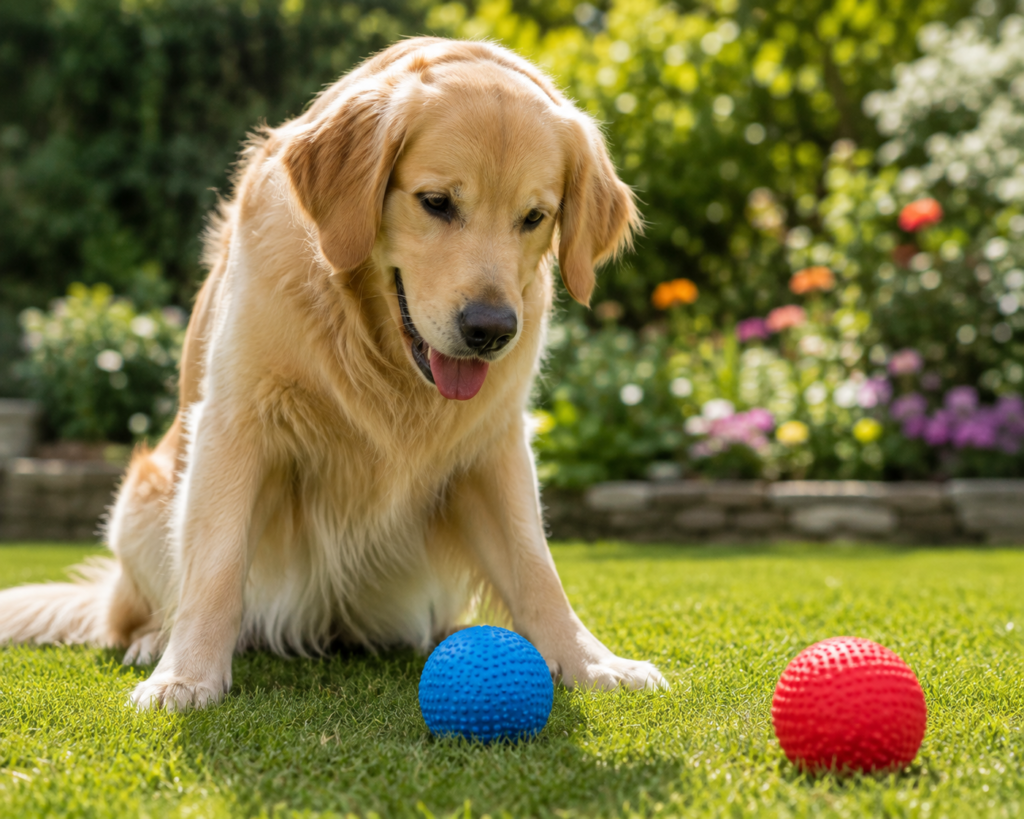
Quick Answer: Dogs can see color, but not the full range that humans do. They have dichromatic vision, meaning they see mainly shades of blue, yellow, and gray. Red and green appear as dull yellowish-brown or gray, which is why a bright red ball can almost disappear in green grass. If you want your dog to spot toys more easily, choose bright blue or yellow instead.
Key Takeaways
- Dogs do not see the world in black and white.
- Dogs have dichromatic vision, meaning they have two types of color-detecting cone cells.
- Blue and yellow are the easiest colors for dogs to recognize.
- Red and green appear as muted shades of yellow, brown, or gray.
- Dogs have better night vision and motion detection than humans.
- Their eyesight is less sharp than ours, with visual acuity of about 20/75.
- All dog breeds see the same range of colors.
Quick Facts: Canine Vision
| Feature | Dog Vision |
|---|---|
| Vision Type | Dichromatic (2 cone cells) |
| Best Colors | Blue and Yellow |
| Hardest Colors to Distinguish | Red and Green |
| Visual Acuity | About 20/75 |
| Greatest Strength | Night vision and motion detection |
If you’ve ever thrown a bright red ball into green grass and wondered why your dog struggled to find it, the answer isn’t stubbornness—it’s the way dogs see the world.
Many people still believe dogs only see in black and white, but that’s a myth. Dogs can see color, just not as many colors as we can. Their eyes are specially designed to detect movement and see well in low light rather than appreciate a full rainbow of colors.
In this guide, you’ll learn what colors dogs can actually see, why red toys are difficult to find, how canine vision compares to human vision, and how choosing the right colors can make playtime and training much easier for your dog.
Why You’ll Find This Guide Helpful
Understanding how your dog sees the world can help you make better choices when buying toys, setting up training sessions, or simply understanding their behavior.
In this guide, you’ll discover:
- ✔ The colors dogs see most clearly
- ✔ Why dogs don’t see red and green like humans
- ✔ How canine vision differs from human vision
- ✔ Why dogs excel at seeing movement in low light
- ✔ The best toy colors for fetch and training
- ✔ Common myths about dog color vision explained by science
Whether you’re choosing a new fetch toy or simply curious about how your dog experiences the world, this guide will help you see things from your dog’s point of view.
Do Dogs See in Black and White?
No. Dogs do not see only in black and white. This is one of the biggest myths about canine vision, and science has shown it’s not true.
Dogs can see color, but they don’t experience the same wide range of colors that humans do. Instead of seeing a full rainbow, they mainly see shades of blue, yellow, and gray.
Although their world isn’t as colorful as ours, dogs don’t need full color vision to thrive. Their eyesight evolved to help them detect movement, hunt in low light, and navigate their surroundings rather than identify bright colors.
Takeaway: Dogs see color—they just see fewer colors than humans.
What Colors Can Dogs See Best?

Dogs see blue and yellow more clearly than any other colors. These are the colors that stand out the most because of the way their eyes are built.
If you’ve ever played fetch, you’ve probably noticed that some toys are easier for your dog to find than others. A bright blue ball stands out well against green grass, making it much easier to spot.
Yellow toys also work well because they provide good contrast in most outdoor environments.
If you regularly buy toys for your dog, choosing blue or yellow can make games more enjoyable and less frustrating.
Takeaway: Blue and yellow are the easiest colors for dogs to recognize, making them the best choices for toys and training equipment.
Why Do Dogs See Fewer Colors Than Humans?
Dogs see fewer colors because they have only two types of cone cells in their retinas, while humans have three.
Cone cells are responsible for detecting color.
Humans have:
- Red-sensitive cones
- Green-sensitive cones
- Blue-sensitive cones
Dogs only have:
- Blue-sensitive cones
- Yellow-sensitive cones
Instead of evolving to see many colors, dogs developed more rod cells, which help detect movement and improve vision in dim light.
This trade-off gave wild dogs an advantage when hunting during dawn and dusk, when movement was far more important than seeing bright colors.
Takeaway: Dogs sacrificed a wider color range in exchange for better motion detection and stronger low-light vision.
How Is Dog Vision Different From Human Vision?
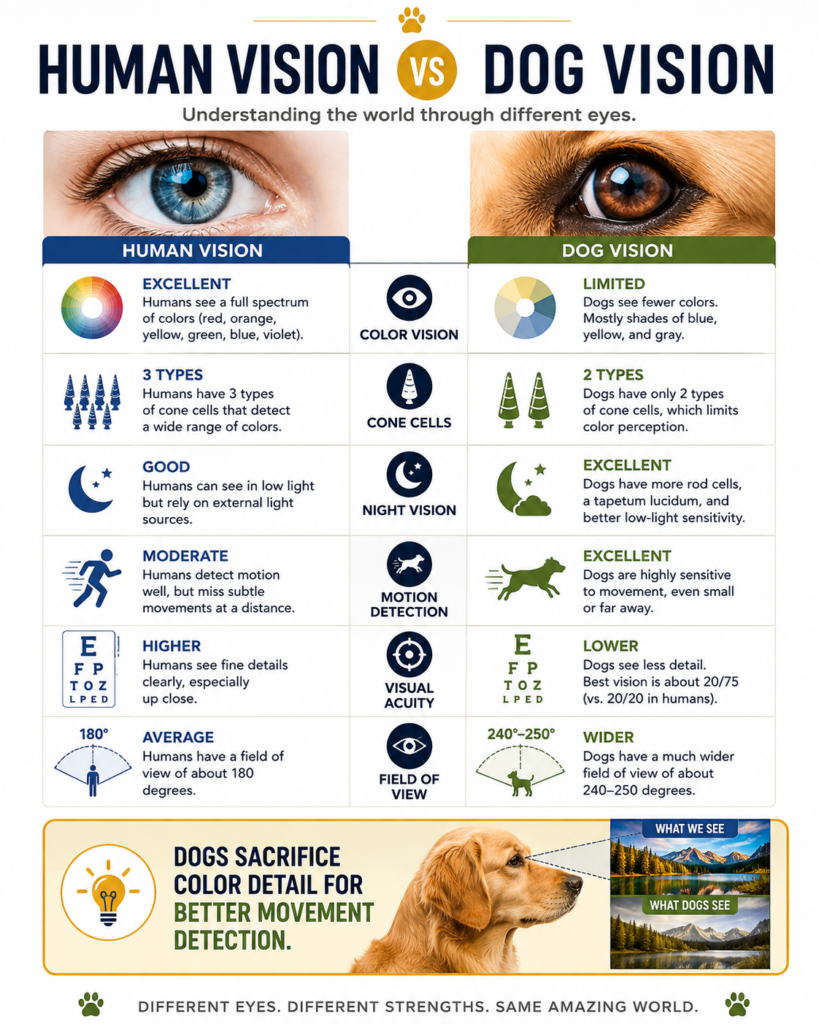
Dogs and humans see the world very differently.
Humans enjoy sharper eyesight and a much wider range of colors, while dogs are better at detecting movement and seeing in low-light conditions.
| Feature | Humans | Dogs |
|---|---|---|
| Color Vision | Red, green, blue | Blue, yellow, gray |
| Cone Cells | 3 | 2 |
| Night Vision | Good | Excellent |
| Motion Detection | Good | Superior |
| Visual Acuity | About 20/20 | About 20/75 |
This means your dog may not notice the color of a toy, but they’ll quickly spot it if it starts moving. Their eyes are designed to notice even slight movements, especially at dawn, dusk, or in dim lighting.
Takeaway: Humans rely on color and sharp detail, while dogs rely on movement, contrast, and excellent night vision.
Do All Dog Breeds See the Same Colors?
Yes. All dog breeds see the same range of colors.
Whether you have a Chihuahua, Labrador Retriever, Border Collie, or Great Dane, every dog has the same two types of cone cells responsible for color vision. This means all breeds see the world primarily in shades of blue, yellow, and gray.
While some breeds may have slightly different eyesight because of the shape of their head or eyes, these differences affect things like field of view or visual sharpness—not the colors they can see.
For example, Border Collies may be excellent at spotting movement because they were bred for herding, but they don’t see more colors than any other breed.
Takeaway: Every dog breed shares the same blue-yellow color spectrum.
Best Color Toys for Dogs to See

If you’re shopping for a new toy, color matters more than most people realize.
The easiest toys for dogs to spot are:
🥇 Bright blue
🥈 Bright yellow
These colors stand out well against grass, dirt, and many indoor floors, making games like fetch much easier.
Toys that are harder for dogs to see include:
- Red
- Green
- Dark brown
These colors often blend into outdoor backgrounds, forcing your dog to rely more on smell than eyesight.
If your dog frequently loses toys in the yard, switching to bright blue or yellow is one of the simplest improvements you can make.
Takeaway: For the best visibility, choose blue or yellow toys instead of red or green.
Frequently Asked Questions
How far can dogs see color?
Dogs can recognize color at moderate distances, but their eyesight isn’t as sharp as ours. With a visual acuity of about 20/75, objects need to be much closer before they appear clear.
What colors look gray to dogs?
Red and green often appear as muted shades of yellow, brown, or gray because dogs don’t have the cone cells needed to distinguish those colors.
Can dogs see television?
Yes. Modern televisions refresh quickly enough for dogs to perceive smooth movement, allowing many dogs to follow animals and action on the screen.
Are dogs completely colorblind?
No. Dogs are not colorblind in the sense of seeing only black and white. They see a limited range of colors, mainly blues, yellows, and shades of gray.
Why does my dog lose red toys in the grass?
Because red and green appear very similar to dogs, a red toy provides little contrast against green grass. Your dog often finds it using scent or movement instead of color.
Do puppies see colors differently than adult dogs?
No. Puppies develop the same type of color vision as adult dogs. Once their eyes have fully developed, they see the same blue-yellow color spectrum as every other dog.
Conclusion
Understanding what colors dogs can see helps you better understand how your dog experiences the world. While dogs don’t see the full rainbow like humans, they aren’t living in a black-and-white world either. Instead, they see a more limited range of colors, mainly blues, yellows, and shades of gray.
This difference explains why some toys are easier for dogs to find than others. A bright blue or yellow toy stands out clearly, while a red toy can almost disappear against green grass. By choosing colors your dog can easily see, you can make games, training sessions, and everyday activities more enjoyable and less frustrating.
Although dogs don’t rely heavily on color, they make up for it with excellent night vision, superior motion detection, and an incredible sense of smell. Together, these abilities help them navigate the world in ways humans simply can’t.
The next time you’re shopping for a new toy or setting up a training exercise, remember to think like your dog. A simple color change can make a surprisingly big difference.
References
- Neitz J, Geist T, Jacobs GH. Color vision in the dog. Vision Research.
https://pmc.ncbi.nlm.nih.gov/articles/PMC3730601/ - Smithsonian Magazine. New Study Shows That Dogs Use Color Vision After All.
https://www.smithsonianmag.com/science-nature/new-study-shows-that-dogs-use-color-vision-after-all-13168563/ - PetMD. What Colors Can Dogs See?
https://www.petmd.com/dog/general-health/what-colors-can-dogs-see - American Kennel Club (AKC). Can Dogs See Color?
https://www.akc.org/expert-advice/health/can-dogs-see-color/ - National Animal Health Foundation. What Colors Can Dogs See?
https://www.nahf.org/article/what-colors-can-dog-see - Miller PE, Murphy CJ. Vision in Dogs. Veterinary Clinics of North America: Small Animal Practice.
https://pmc.ncbi.nlm.nih.gov/articles/PMC5717654/ - PubMed. Ultraviolet Vision in Dogs: Current Research.
https://pubmed.ncbi.nlm.nih.gov/39903295/ - Scientific American. What Colors Do Dogs See?
https://www.scientificamerican.com/article/what-colors-do-dogs-see/