

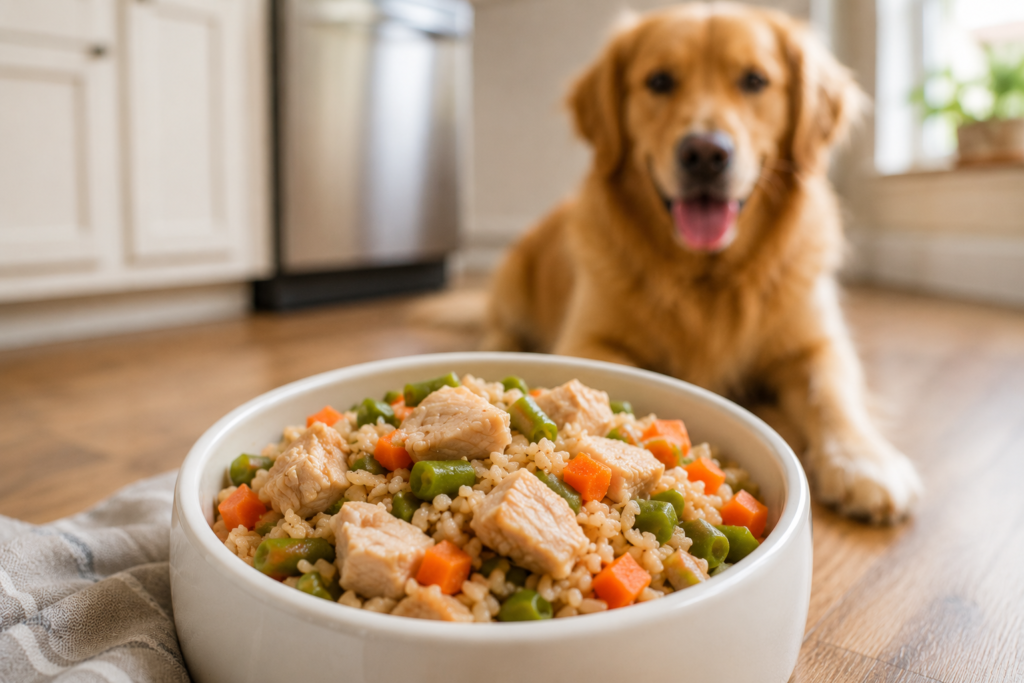
Quick Answer: Homemade dog food can give you more control over the ingredients in your dog’s bowl. This recipe combines cooked chicken, brown rice, carrots, green beans, fish oil, and a veterinarian-approved supplement.
However, meat, rice, and vegetables alone do not provide all the nutrients a dog needs for long-term health. Homemade diets need careful formulation to be complete and balanced for the individual dog’s life stage and needs. AAFCO notes that creating a nutritionally complete homemade diet is complex because dogs require many nutrients in specific amounts and ratios.
Important: If you plan to feed homemade food as your dog’s main diet, work with your veterinarian or a board-certified veterinary nutritionist to make sure the recipe and supplement meet your dog’s nutritional needs.
Recipe at a Glance
| Prep Time | Cook Time | Total Time | Yield |
|---|---|---|---|
| 15 minutes | 25 minutes | 40 minutes | 6 standard servings |
Main ingredients: Chicken, brown rice, carrots, green beans, fish oil, and a veterinarian-approved supplement.
Best for: An adult dog whose homemade diet has been appropriately formulated or approved by their veterinarian.
Key Takeaways
- Homemade dog food gives you control over the ingredients you use.
- A mixture of meat, rice, and vegetables is not automatically a complete and balanced diet.
- Long-term homemade diets need appropriate vitamin and mineral supplementation and careful formulation.
- Puppies, pregnant or nursing dogs, and dogs with medical conditions have different nutritional requirements and should not be placed on this recipe without veterinary guidance.
- Cook the chicken thoroughly and serve the food plain, without onions, garlic, excess salt, or seasonings.
- Introduce a new diet gradually rather than switching your dog overnight.
- Portion size depends on your dog’s calorie needs, body condition, age, activity, and health.
- Refrigerate leftovers for about 3–4 days or freeze individual portions for longer storage.
If you’ve ever wanted to know exactly what goes into your dog’s food bowl, homemade dog food can be appealing.
You can choose the protein, carbohydrate, and vegetables yourself and prepare everything in your own kitchen. This recipe combines chicken with brown rice, carrots, and green beans for a simple cooked meal.
But there is an important difference between homemade food and a complete and balanced diet.
Dogs need many essential nutrients in the right amounts and ratios. A homemade recipe can look healthy while still being deficient in important nutrients. AAFCO explains that formulating complete and balanced pet food is a complex process, with different requirements for different life stages.
So, if you’re making this recipe as your dog’s regular food, don’t skip the veterinary formulation or appropriate supplement.
In this guide, I’ll show you how to prepare the recipe, how much to feed, how to adapt it, what ingredients to avoid, and how to store it safely.
Why You’ll Love This Homemade Dog Food
One of the biggest advantages of making your dog’s food at home is knowing exactly which ingredients you’re using.
This recipe uses familiar ingredients that are easy to find:
- Chicken
- Brown rice
- Carrots
- Green beans
- Fish oil
- A veterinarian-approved supplement
You can also make ingredient changes when your veterinarian recommends a different protein, carbohydrate, or vegetable for your dog.
Another benefit is that you can prepare several portions at once and store them for later.
However, homemade food should not be considered automatically healthier than commercial food. A commercial diet that is labeled complete and balanced is formulated to provide the required nutrients for its intended life stage.
Takeaway: Homemade food gives you ingredient control, but nutritional balance is what makes a long-term diet appropriate for your dog.
Ingredients You’ll Need
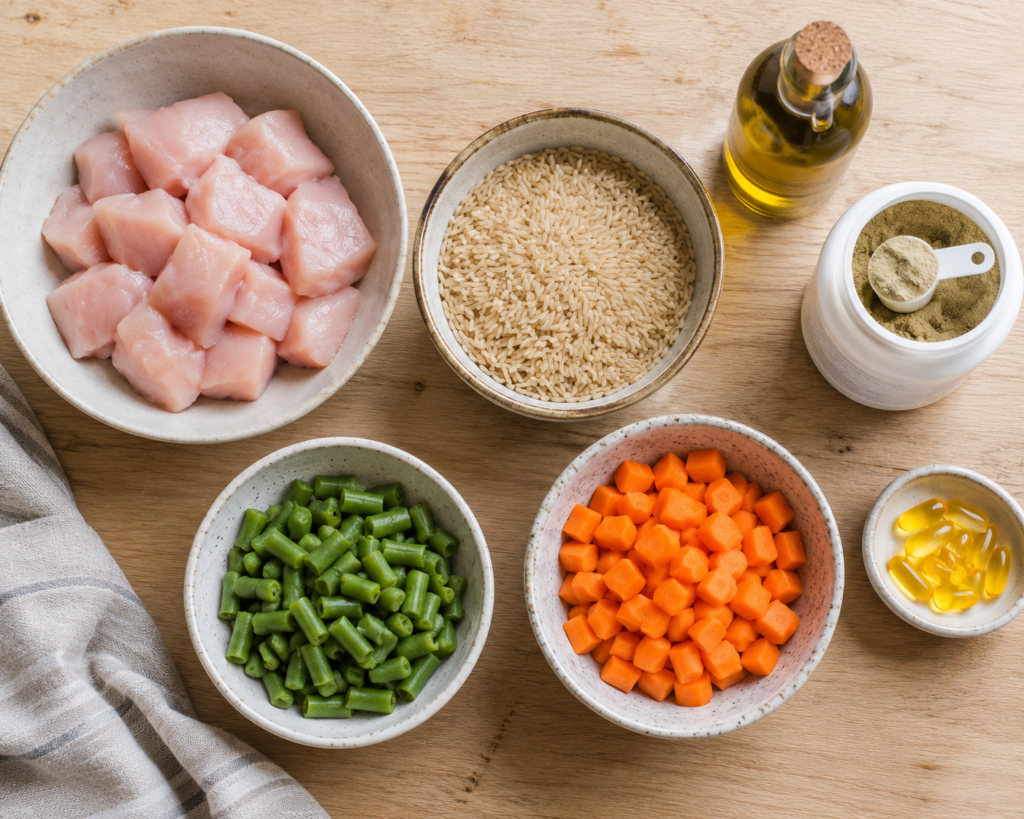
Main ingredients
- 1 lb (454 g) boneless, skinless chicken breast or thigh, diced
- 1 cup (200 g) brown rice, uncooked
- 1/2 cup (65 g) carrots, diced
- 1/2 cup (65 g) green beans, chopped
- 1 tablespoon (15 ml) fish oil
- Veterinarian-approved calcium and vitamin/mineral supplement, used according to your veterinary formulation
Before you start
The exact supplement, amount, and overall recipe should be based on your dog’s nutritional requirements if this food will replace their regular diet.
If you’re preparing this recipe simply as a temporary meal or topper, the nutritional requirements are different from those of a complete long-term diet.
How Do I Make Homemade Dog Food for My Dog?
This recipe is simple to prepare. You’ll cook the rice, chicken, and vegetables separately before combining them.
1. Cook the rice
Place the brown rice and 2 cups (473 ml) of water in a large pot.
Bring it to a boil, then reduce the heat and cover the pot. Simmer until the rice is tender and has absorbed the water, about 30 minutes.
2. Cook the chicken
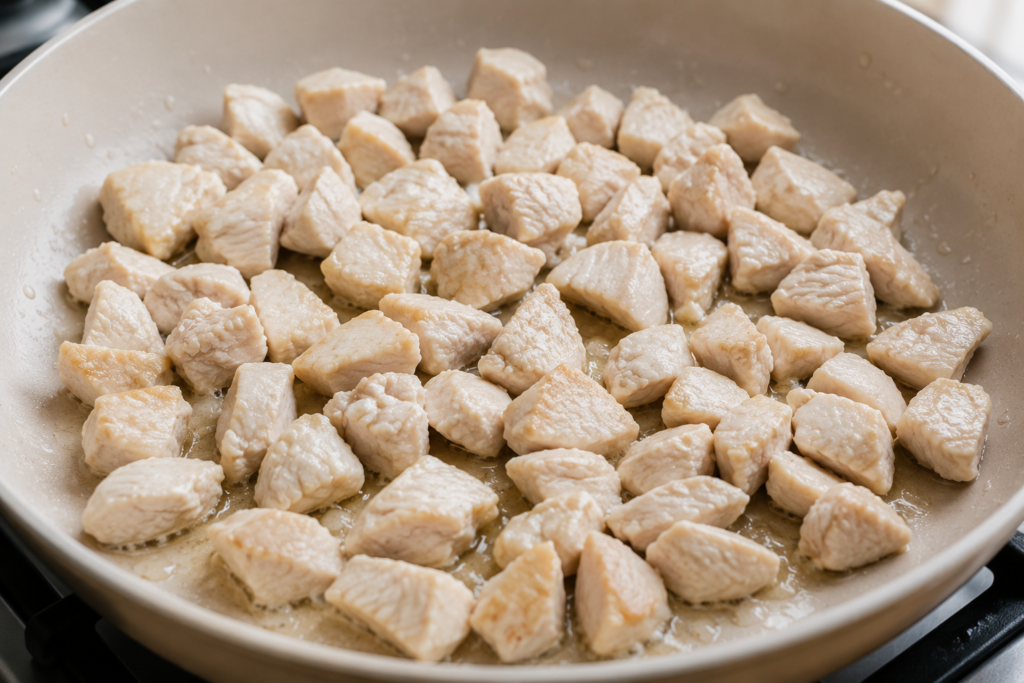
Place the diced chicken in a separate skillet over medium heat.
Cook until the chicken is completely opaque and cooked through, about 8 minutes, stirring occasionally.
Do not add salt, onions, garlic, butter, or seasoning.
3. Cook the vegetables
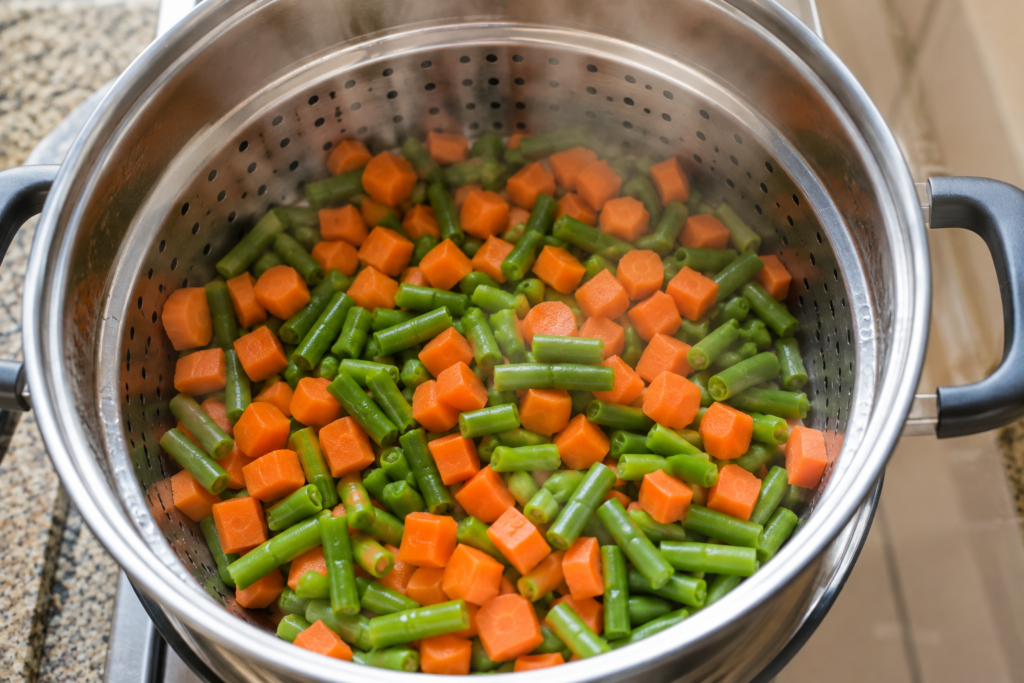
Steam the carrots and green beans until they are tender and can be easily pierced with a fork, about 5 minutes.
4. Combine everything
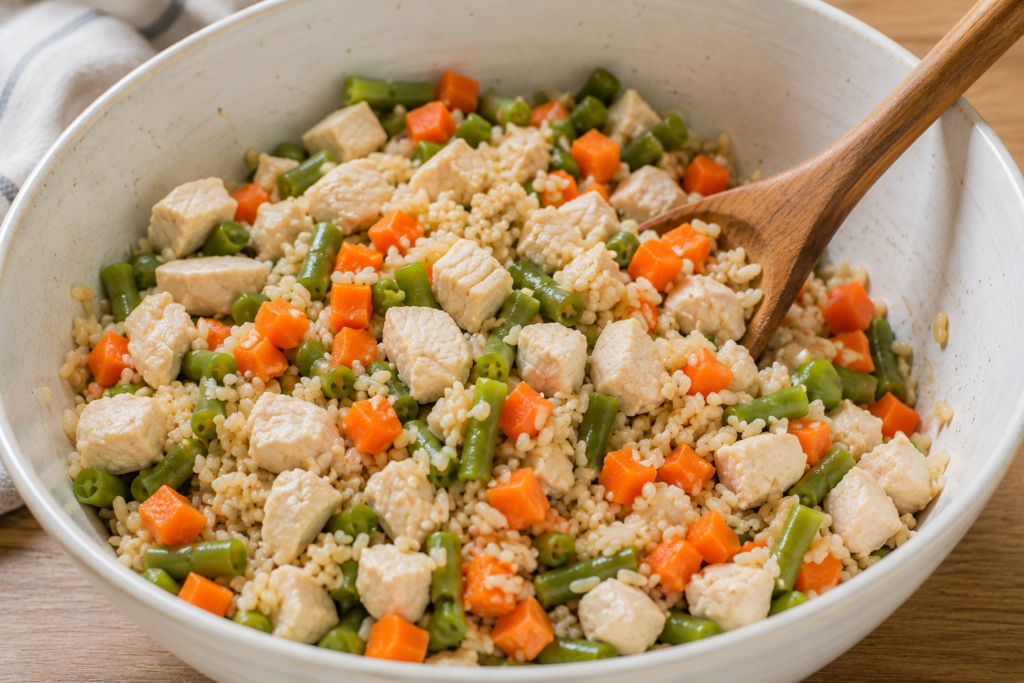
Add the cooked rice, chicken, carrots, and green beans to a large bowl.
Mix everything together and allow the food to cool completely before serving.
5. Add the supplement and fish oil
Stir in the fish oil and the veterinarian-approved supplement according to your dog’s specific formulation.
Do not guess the supplement amount.
How Much Homemade Dog Food Should I Feed My Dog?
There isn’t one serving size that is correct for every dog.
The amount your dog needs depends on:
- Body weight
- Age
- Activity level
- Current body condition
- Metabolism
- Health conditions
- Calorie density of the finished food
Your original recipe gives 1/2 cup per 10 pounds of body weight per day as a general starting point, split between two meals. However, this should not be treated as a universal feeding recommendation because homemade recipes can vary considerably in calorie density.
A better approach is to use your veterinarian’s recommended calorie intake and monitor your dog’s body condition and weight.
If your dog starts gaining or losing weight unexpectedly, the portion may need to be adjusted.
Takeaway: Don’t rely on a fixed cup-per-pound rule for every dog. Feeding amounts should be based on the dog’s individual calorie needs and the actual recipe.
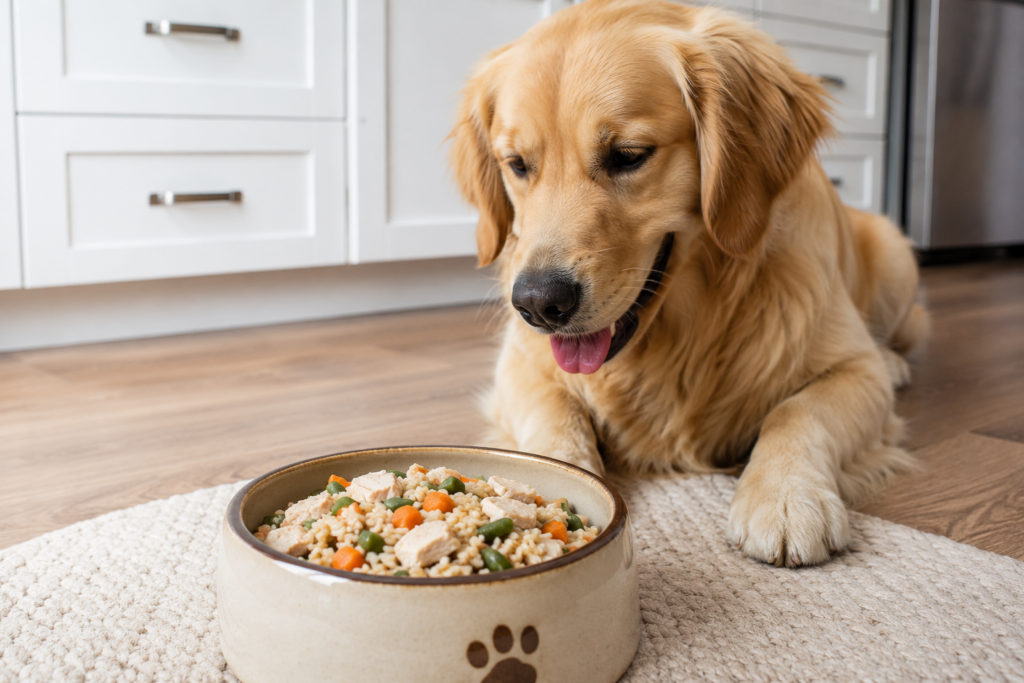
Is Homemade Dog Food Safe for All Dogs?
Not automatically.
A homemade diet that works for one adult dog may not be appropriate for another dog.
Puppies
Growing puppies have different nutrient requirements from adult dogs. A diet that is suitable for an adult dog may not provide the right amounts or ratios of nutrients needed for growth.
Do not feed this recipe as a puppy’s sole diet unless it has been specifically formulated for growth by a veterinary nutrition professional.
Pregnant or nursing dogs
Pregnancy and nursing require different nutritional support. A homemade recipe should be specifically formulated for these stages.
Dogs with medical conditions
Dogs with kidney disease, liver disease, diabetes, food allergies, urinary problems, or other medical conditions may need carefully controlled diets.
If your dog has a medical condition or eats a prescription diet, talk to your veterinarian before making homemade food their main diet.
Can an unbalanced homemade diet cause problems?
Yes.
Long-term nutritional deficiencies or excesses can cause serious health problems. AAFCO notes that complete and balanced diets require nutrients in appropriate amounts and ratios, and that these requirements vary by life stage.
Takeaway: Homemade food can be appropriate for some dogs, but a long-term diet should be properly formulated for the individual dog.
What Ingredients Should I Avoid in Homemade Dog Food?
Some human foods are toxic to dogs and should never be included.
Avoid:
- Onions
- Garlic
- Grapes
- Raisins
- Macadamia nuts
- Chocolate
- Xylitol
Also avoid adding unnecessary salt, butter, sauces, or seasonings.
What about raw meat?
This recipe uses cooked chicken rather than raw meat. Cooking meat thoroughly helps reduce exposure to foodborne pathogens.
For a homemade diet, food safety matters for both your dog and the people handling the food.
Takeaway: Keep homemade dog food plain and avoid known toxic ingredients.
Common Mistakes to Avoid
1. Feeding meat and vegetables without balancing the diet
Chicken, rice, and vegetables may look nutritious, but appearance isn’t enough to determine whether a diet is complete.
2. Guessing the supplement amount
More supplement isn’t necessarily better. Some nutrients can become harmful when given in excessive amounts.
Use the supplement and amount specified for your dog’s formulation.
3. Adding seasonings
Dogs don’t need salt, garlic, onion, sauces, or spicy seasonings added to their food.
4. Changing several ingredients at once
If you’re making a diet change under veterinary guidance, changing one thing at a time can make it easier to identify digestive problems or food reactions.
5. Switching diets too quickly
A gradual transition can help reduce digestive upset.
How Long Does Homemade Dog Food Last in the Fridge?
Your homemade dog food can be stored in an airtight container in the refrigerator for about 3–4 days.
For longer storage, divide the food into individual portions and freeze them.
Your original recipe gives a freezer storage time of up to 2 months.
When you’re ready to use a frozen portion, thaw it in the refrigerator before serving.
Always discard food that develops an unusual smell, appearance, or texture.
Frequently Asked Questions
Can I feed my dog chicken and rice every day?
Chicken and rice alone should not be used as a complete long-term diet. If you’re feeding homemade food as your dog’s main diet, it needs to be properly balanced with the nutrients your dog requires.
Does homemade dog food need a supplement?
A properly formulated homemade diet often requires a specific vitamin and mineral supplement. The correct supplement and amount depend on the recipe and the individual dog’s nutritional requirements.
Can puppies eat this homemade dog food recipe?
Not as their sole diet unless the recipe has been specifically formulated for growth. Puppies have different nutritional requirements from adult dogs.
Conclusion
Making homemade dog food gives you control over the ingredients in your dog’s bowl, but it also comes with an important responsibility: the diet must provide the nutrients your dog needs.
This recipe combines chicken, brown rice, carrots, green beans, fish oil, and a veterinarian-approved supplement. It can be a useful starting point for an appropriately formulated homemade diet, but the recipe should not be assumed to be complete and balanced for every dog.
If you’re planning to replace commercial food with homemade food long term, work with your veterinarian or a board-certified veterinary nutritionist. Your dog’s age, size, activity level, health, and life stage all affect their nutritional requirements.
For a healthy adult dog whose diet has been properly formulated, preparing several portions at once can make homemade feeding more convenient.