


Dogs often sleep at their owner’s feet because the spot provides closeness, warmth, security, and a familiar scent. For most dogs, foot sleeping is a normal attachment behavior rather than a sign of dominance or submission. It becomes more concerning when the behavior appears suddenly or comes with anxiety, pain, restlessness, or other changes in behavior. [1][4]
The position also gives your dog a little independence. They can stay close to you while still having enough space to settle comfortably and remain aware of what is happening around them.
Table of Contents
Quick Answer: Why Dogs Sleep at Your Feet
The most common reasons include:
- Security: Your presence can help your dog feel safe while resting.
- Comfort and warmth: Your feet provide a familiar, warm place to settle.
- Attachment: Staying physically close can be part of a healthy human-dog bond.
- Familiar scent: Your feet carry a strong concentration of your scent.
- Protection: Some dogs prefer a position that lets them watch the room.
- Anxiety: In some dogs, excessive proximity can be linked to separation distress or difficulty settling alone. [4][7][13]
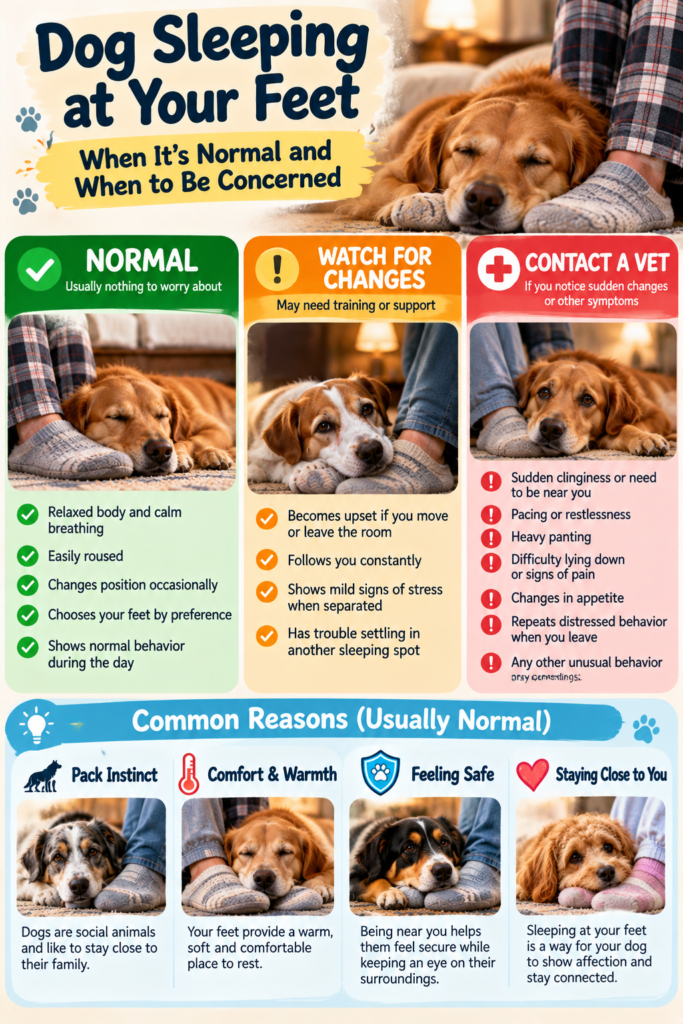
Behavioral Triage: Foot Sleeping
| What you notice | What it may mean |
|---|---|
| Relaxed body, normal breathing, easily roused | Usually normal |
| Dog becomes distressed when you move or leave | May need behavioral support |
| Sudden clinginess, pacing, panting, or difficulty lying down | Veterinary assessment may be appropriate |
Why Dogs Sleep at Their Owner’s Feet
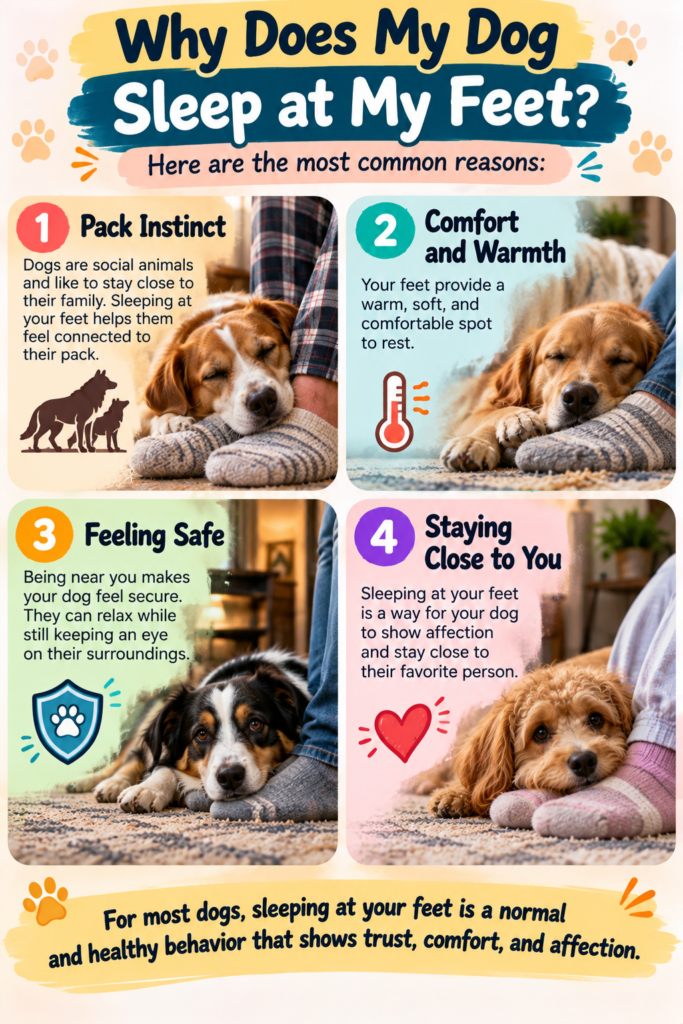
Sleeping at your feet allows a dog to remain close to a trusted person while resting. Dogs are social animals, and proximity can provide a sense of security. The position may also offer warmth and access to a familiar scent. [1][2]
The exact reason can vary from one dog to another. Some dogs simply find the foot of the bed or sofa comfortable, while others appear to choose the location because they want to stay connected to their person without being directly on top of them.
Many owners don’t realize that foot sleeping can also give a dog a useful balance between closeness and personal space. Your dog can settle near you while still being able to change position or get up easily.
Practical tip: If your dog is relaxed and sleeping normally, there’s usually no need to discourage foot sleeping. If you prefer a different sleeping arrangement, introduce an appealing dog bed nearby rather than repeatedly pushing your dog away.
Normal Foot Sleeping and Healthy Attachment
For most dogs, sleeping at their owner’s feet is a normal behavior. A relaxed dog that settles down, changes position occasionally, breathes normally, and can get up when needed is generally showing ordinary resting behavior. [3][5]
Your scent may be part of the appeal. Dogs rely heavily on smell, and your feet can provide a familiar scent while the position itself offers warmth and physical proximity. [4][8]
The behavior is only a problem if it prevents your dog from resting independently, interferes with normal daily activities, or occurs alongside signs of distress.
If you enjoy having your dog nearby, there’s no inherent reason to stop the behavior. Still, it’s useful to give your dog another comfortable sleeping option so they can choose where to rest.
Comfort, Protection, and the Myth of Dominance
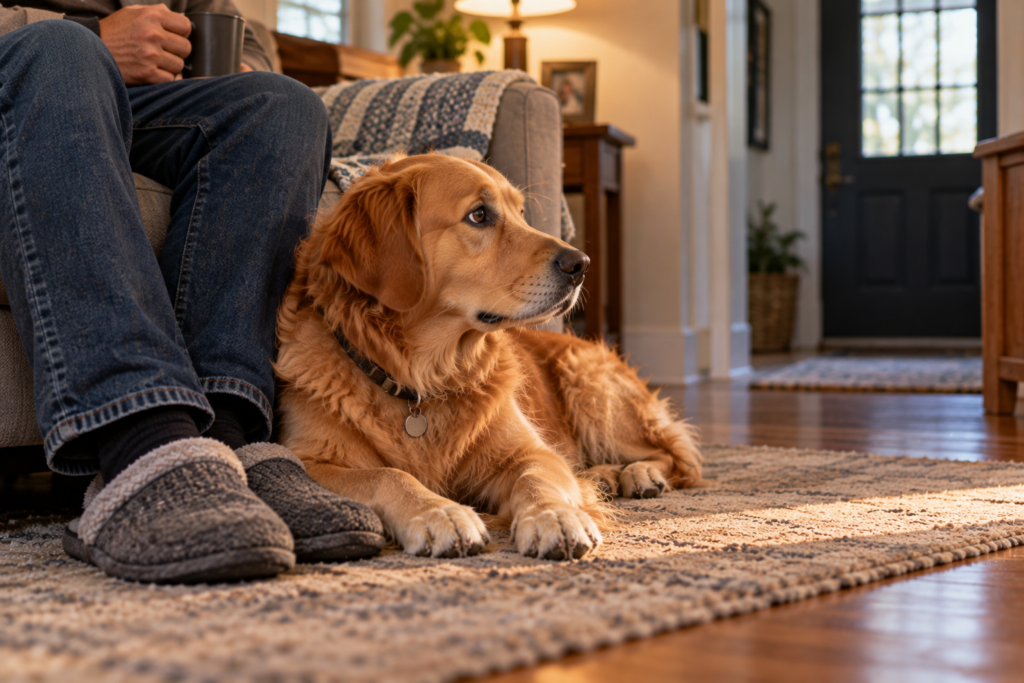
Dogs may choose your feet because the location combines comfort with awareness of their surroundings. A dog positioned near your feet can remain close to you while facing outward toward the room, doorway, or other activity. [6][9]
That positioning can look protective, but it shouldn’t automatically be interpreted as guarding behavior. Dogs have individual sleeping preferences, and the position alone cannot tell you what a dog is thinking.
Older interpretations sometimes framed proximity behaviors through a dominance or pack-leader model. The supplied sources instead describe foot sleeping primarily in terms of social connection, security, and attachment. [3][9]
One useful clue is your dog’s overall body language. A relaxed dog that occasionally watches the room and then settles back down is different from a dog that remains tense, repeatedly reacts to sounds, or cannot relax.
Anxiety and Excessive Clinginess
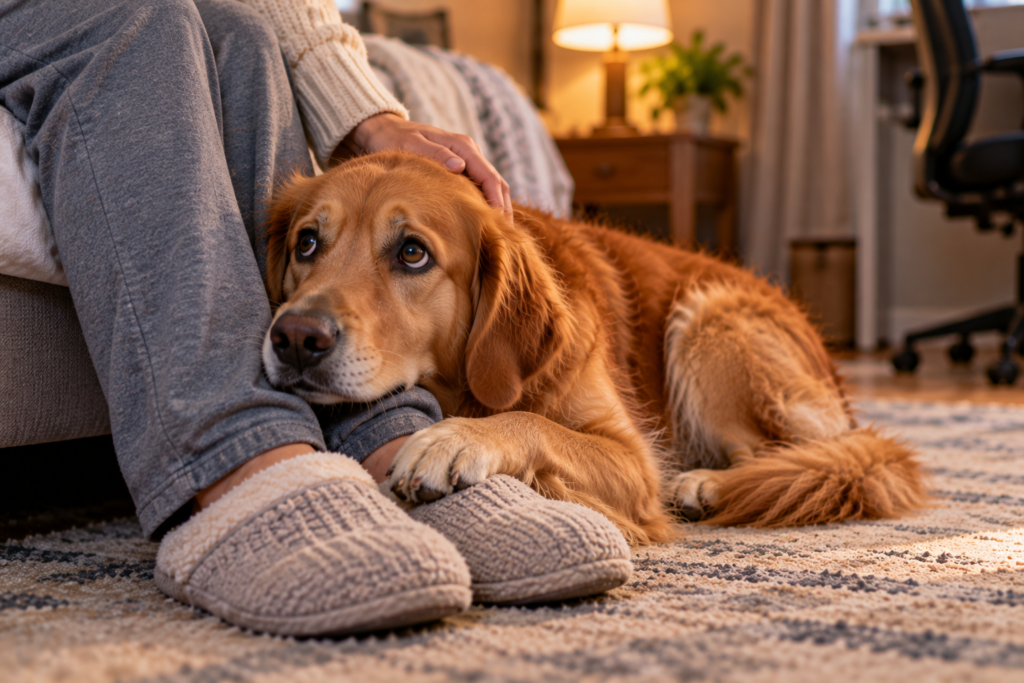
Foot sleeping can sometimes be connected with anxiety, particularly when a dog struggles to settle away from its owner. The sleeping position itself doesn’t diagnose separation anxiety; the surrounding behavior matters much more. [7][13][14]
Look at what happens when you move or leave. A dog that calmly remains on its bed or gets up and follows you occasionally is different from one that becomes frantic, pants, paces, vocalizes, or shows destructive behavior when separated.
Stress can also make a dog seek more physical proximity than usual. Changes in routine, environment, or the dog’s emotional state may contribute to this pattern. [13][14]
A common mistake is assuming that every clingy behavior is simply affection. If your dog’s need to stay beside you is increasing or interfering with normal life, keep track of when it happens and discuss the pattern with a qualified veterinary or behavioral professional.
How to Encourage Your Dog to Sleep in Their Own Bed
If you want your dog to stop sleeping at your feet, make an alternative sleeping spot more rewarding rather than forcing the dog away. A comfortable bed placed close to you is usually an easier starting point than moving the dog immediately to another room. [1][2]
Try this gradual approach:
- Choose a comfortable bed. Pick one that suits your dog’s size and preferred sleeping position.
- Place it beside your feet. This lets your dog remain close while learning that the new spot is comfortable.
- Reward voluntary use. Give praise or an appropriate treat when your dog chooses the bed.
- Move it gradually. Once your dog is consistently comfortable, shift the bed a little farther away.
- Stay consistent. Everyone in the household should use the same approach.
Avoid repeatedly dragging, pushing, or scolding your dog away from your feet. Positive reinforcement gives the dog a clear alternative instead of simply removing access to the place they find comforting.
For owners considering a new sleeping surface, a supportive dog bed may be useful when comfort or mobility is part of the reason your dog chooses a particular location.
When a Change in Sleeping Behavior Needs Attention
A sudden change matters more than the fact that your dog sleeps at your feet. If a dog that normally sleeps elsewhere suddenly becomes unusually clingy, restless, or unable to settle, consider whether something else has changed. Pain, discomfort, anxiety, or illness can sometimes alter normal resting behavior. [1][4]
Watch for changes such as pacing, heavy panting, reluctance to lie down, unusual vocalization, changes in appetite, or obvious discomfort.
Safety Triage: When to Call the Vet
Usually monitor:
Your dog is relaxed, breathing normally, sleeping comfortably, changing positions normally, and behaving as usual when awake.
Call your veterinarian today:
Your dog suddenly becomes much more clingy and also shows discomfort, pacing, appetite changes, repeated panting, or difficulty settling.
Seek emergency veterinary care:
Your dog is unable to settle and appears severely distressed, cries out in pain, pants heavily, collapses, or shows other signs of a serious medical problem.
Don’t focus only on the sleeping position. The combination of sudden behavioral change + physical symptoms is much more meaningful than foot sleeping by itself.
Frequently Asked Questions
Do all dog breeds sleep at their owner’s feet?
No. Sleeping preferences vary between individual dogs as well as breeds. Some dogs prefer close physical contact, while others may choose a bed, crate, doorway, or another quiet location. Breed tendencies may influence behavior, but your dog’s individual temperament, routine, environment, and relationship with you are also important. [6]
Is sleeping at your feet better than sleeping on your bed?
Neither position is automatically better. Sleeping at your feet allows a dog to remain close while retaining more personal space, whereas sleeping on the bed provides greater physical contact. The more useful question is whether your dog is comfortable, can settle normally, and has access to an appropriate alternative sleeping area. [8]
Can a dog sleep at your feet because it feels unsafe?
It can be one reason, but foot sleeping alone doesn’t show that a dog feels unsafe. Look at the rest of the dog’s body language and behavior. A relaxed dog that chooses your feet may simply enjoy your warmth and presence. A dog that becomes tense, frantic, or unable to separate from you may need closer attention. [7][13]
Why does my dog follow me after sleeping at my feet?
Following you can be part of normal social behavior, particularly in dogs that enjoy staying near their family. It becomes more concerning if your dog cannot settle without you, panics when you leave, or develops destructive or distressed behavior during separation. In those cases, discuss the pattern with your veterinarian or a qualified behavior professional. [13]
Can puppies sleep at their owner’s feet?
Puppies may seek close sleeping locations because they are adjusting to a new environment and developing their relationship with their caregivers. Providing a comfortable, safe sleeping area can help a puppy learn to settle independently while still allowing appropriate closeness and reassurance.
Should I move my dog if they sleep at my feet every night?
Not necessarily. If your dog is relaxed and you don’t mind the behavior, there is usually no need to move them. If you want more space, teach your dog to use a comfortable bed nearby and gradually increase the distance. Rewarding the preferred behavior is generally more useful than repeatedly removing the dog from your feet. [1][2]
Why does my dog sleep at my feet instead of beside me?
Your feet may offer a combination of familiar scent, warmth, closeness, and space. The location also lets a dog remain near you without lying directly against your body. Individual preference matters, so there’s no single explanation that applies to every dog. [4][8]
Is sleeping at my feet a sign that my dog loves me?
It can be consistent with a strong attachment, but sleeping position alone isn’t a reliable measure of how a dog feels about a person. Relaxed proximity, seeking interaction, and choosing to spend time near you can all be parts of a healthy relationship. Look at your dog’s overall behavior rather than treating one sleeping position as a definitive signal.
Conclusion
For most dogs, sleeping at your feet is a simple way to stay close to a trusted person while remaining comfortable and relaxed. Warmth, familiar scent, security, and individual sleeping preferences can all contribute to the choice.
The behavior itself usually isn’t something to worry about. What deserves more attention is a sudden change accompanied by anxiety, pain, restlessness, heavy panting, appetite changes, or other unusual behavior.
If you’d like your dog to sleep somewhere else, give them a comfortable alternative and gradually reward them for choosing it. The goal isn’t to punish closeness; it’s to teach your dog that another resting place can feel just as safe.
References
[1] Why Does My Dog Sleep At My Feet — Carey Animal Hospital
https://careyanimalhospital.com/blog/why-does-my-dog-sleep-at-my-feet/
[2] Dog Sleep Behavior At Feet — PetsCare
https://www.petscare.com/en-gb/news/post/dog-sleep-behavior-at-feet
[3] Watch — YouTube
https://www.youtube.com/watch?v=NSv7kq61GdU
[4] Why Do Dogs Sleep At Your Feet — Furry Critter
https://www.furrycritter.com/pages/articles/dogs/why_do_dogs_sleep_at_your_feet.htm
[5] Watch — YouTube
https://www.youtube.com/watch?v=KACWQY4VAC4
[6] Why Dogs Sleep At Your Feet — Dog Breeds FAQ
https://dogbreedsfaq.com/why-dogs-sleep-at-your-feet/
[7] Why Does My Dog Sleep At My Feet — Rover
https://www.rover.com/blog/why-does-my-dog-sleep-at-my-feet/
[8] Why Does My Dog Sleep At My Feet — In Honor of Design
https://mail.inhonorofdesign.com/why-does-my-dog-sleep-at-my-feet/
[9] Dog Sleeping Someone Feet Sign — AOL
https://www.aol.com/articles/dog-sleeping-someone-feet-sign-132122073.html
[10] Why Do Pets Typically Sleep At Their Owners’ Feet — Reddit
https://www.reddit.com/r/explainlikeimfive/comments/15318k/why_do_pets_typically_sleep_at_their_owners_feet/