

Quick Answer
A dog DNA test is a genetic screening kit that analyzes a dog’s cheek-swab or blood sample to identify breed ancestry, relatives, and inherited health risks. It works by extracting DNA, scanning it with a microarray chip for thousands of genetic markers, and comparing the pattern against a reference database of known breeds. Most kits cost between $60 and $250 and deliver results in two to four weeks, depending on the brand and panel selected.
Key Takeaways
- A dog DNA test reads genetic markers (SNPs) from a cheek swab, not fur or saliva alone, to estimate breed mix, ancestry, and sometimes health risk.
- Accuracy depends heavily on the size of the reference database; bigger databases mean better breed matching, especially for mixed breeds.
- Prices typically range from $60 to $250, with health-focused panels costing more than breed-only kits.
- Results usually take 2 to 4 weeks, though some labs offer faster turnaround for breed-only reports.
- DNA tests are a tool, not a diagnosis, vets use the results alongside physical exams, not as a replacement for them.
- A dog DNA test is not the same as pedigree registration through a breed registry like The Kennel Club.
- Breeders should treat DNA testing as one part of responsible breeding decisions, not a substitute for full veterinary health screening.
What Is a Dog DNA Test and How Does It Work, Exactly?
Find Your Best Dog DNA Test Match
A dog DNA test is a consumer genetic kit that extracts DNA from a dog’s cells (usually from a cheek swab) and compares specific genetic markers against a reference library of known dog breeds and health conditions. The core idea: every dog’s DNA carries small, identifiable patterns inherited from its ancestors, and labs can read those patterns to estimate breed composition, relatedness, and certain inherited traits.
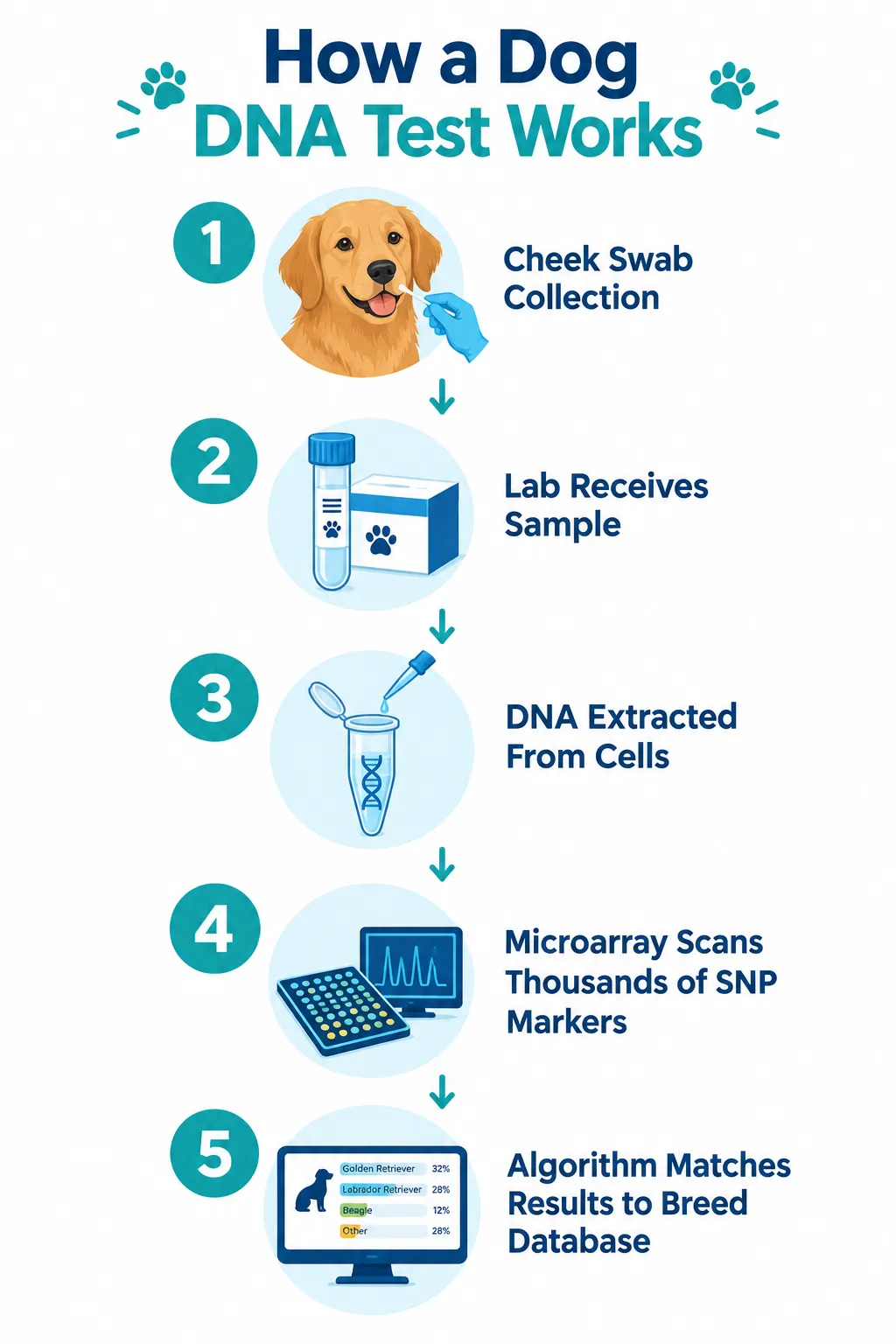
The process is built on a technology called a microarray, a small chip studded with probes that detect single nucleotide polymorphisms, or SNPs, tiny variations in DNA sequence that differ between breeds and individuals. Embark, one of the larger players in this space, explains that its tests scan more than 230,000 genetic markers per dog, far more than many competitors [3]. That marker density is what allows labs to detect not just primary breed but also smaller amounts of ancestry several generations back.
Choose a dog DNA test if you want breed curiosity answered, want an early flag for inherited disease risk, or need relatedness data for breeding decisions. Skip it if you only want a veterinary diagnosis, that still requires a vet visit and, often, targeted bloodwork.
What Can a Dog DNA Test Tell You?
A dog DNA test can reveal breed ancestry percentages, estimated relatives in the company’s database, physical trait predictions (like coat color or size), and in many panels, genetic health risk markers. It does not predict personality with certainty and cannot diagnose an existing illness.
Specifically, most mainstream kits report on:
- Breed mix, percentage breakdown across detected breeds, often down to small single-digit contributions.
- Ancestry depth, how far back in the family tree a breed signal appears (parent, grandparent, great-grandparent level).
- Physical traits, predicted adult weight, coat type, and sometimes eye color.
- Health markers, presence of genetic variants linked to conditions such as degenerative myelopathy or certain drug sensitivities [10].
- Relative matching, connections to other dogs tested through the same company’s database, similar to human ancestry sites.
A common mistake: assuming a DNA test replaces a veterinary diagnosis. It flags risk, not disease. A dog showing a risk variant for a condition may never develop symptoms, and a dog without the marker can still develop unrelated health issues.
How Does a Dog DNA Test Work Step by Step?
A dog DNA test works through four main stages: sample collection, DNA extraction, microarray genotyping, and algorithmic comparison against a breed and health reference database. The entire lab process typically takes one to three weeks once the sample arrives.
Here’s what happens after a sample ships to the lab:
- Collection, the owner swabs the inside of the dog’s cheek for 30-60 seconds, avoiding food or water beforehand so saliva samples aren’t diluted [4].
- Extraction, lab technicians isolate DNA from the cheek cells using chemical processing.
- Genotyping, the DNA is run across a microarray chip that reads tens or hundreds of thousands of SNP markers [3][9].
- Comparison, proprietary algorithms match the dog’s marker pattern against a database built from thousands of previously tested, breed-verified dogs.
- Reporting, results are compiled into a digital report, often viewable through an app or online portal.
Edge case: low-quality or contaminated swabs (taken right after eating, or shared with another pet) can delay results or force a re-test, so following collection instructions matters more than most owners expect.
How Accurate Are Dog DNA Tests, Really, and Can They Be Wrong?
Dog DNA tests are generally reliable for identifying primary breed ancestry, but accuracy drops for distant or very small percentage contributions, and results can occasionally be wrong due to database gaps or close genetic similarity between related breeds. No consumer dog DNA test is 100% infallible.
Marketing claims of “99% accurate” typically refer to the accuracy of detecting a known breed signature already in the reference database, not a guarantee that every distant ancestor will be caught [1]. Three factors drive accuracy:
- Database size, companies with larger libraries of verified purebred dogs can match ancestry more precisely.
- Breed similarity, closely related breeds (like different herding types) can be harder to distinguish genetically.
- Sample quality, a weak or contaminated swab can produce an incomplete read.
Common mistake: expecting a DNA test to be as clinically exact as a human paternity test. Dog breed genetics overlap more than many owners assume, so a “10% Chihuahua” result should be read as a probability estimate, not a certainty.
Best Dog DNA Test Kits Compared
The best dog DNA test kit depends on whether the priority is breed detail, health screening depth, price, or turnaround speed, there isn’t one universal winner. Compare the main differences below before choosing.
| Test Kit | Breed Database Size | Health Screening | Typical Price | Turnaround |
|---|---|---|---|---|
| Embark | 350+ breeds/types [9] | Extensive (genetic diseases, traits) | $130,$250 | 2-3 weeks |
| Wisdom Panel | 350+ breeds | Moderate to extensive, tiered | $90,$180 | 2-4 weeks |
| DNA My Dog | Smaller, breed-focused | Limited | $70,$100 | 2-3 weeks |
| Orivet | Mid-size database | Breed-specific disease panels | $60,$150 | 2-4 weeks |
Decision rule: choose a broader database kit (like Embark or Wisdom Panel) if the dog is a complex mixed breed; choose a budget breed-only kit if the sole goal is a quick breed guess for curiosity’s sake.
How Much Does a Dog DNA Test Cost and How Long Do Results Take?
A dog DNA test typically costs between $60 and $250, and results usually arrive within 2 to 4 weeks after the lab receives the sample [2][5]. Price scales mainly with the depth of health screening included, not just breed detection.
Rough cost breakdown:
- Breed-only kits: $60,$100
- Breed plus basic health markers: $100,$150
- Full health and trait panels: $150,$250
Turnaround time depends on lab volume and shipping, with some companies offering faster processing during off-peak seasons. A quick example: an owner who swabs a dog on a Monday and ships it that day might see results in the account dashboard roughly three weeks later, with email updates at each lab milestone.
What Breeds Will Show Up on a Mixed-Breed DNA Test?
A mixed-breed DNA test will show every breed detected above the company’s minimum reporting threshold, often as low as 2-5% of total ancestry, based on comparison to its reference database. If a breed isn’t in the company’s database, it simply can’t be detected, even if it’s genetically present.
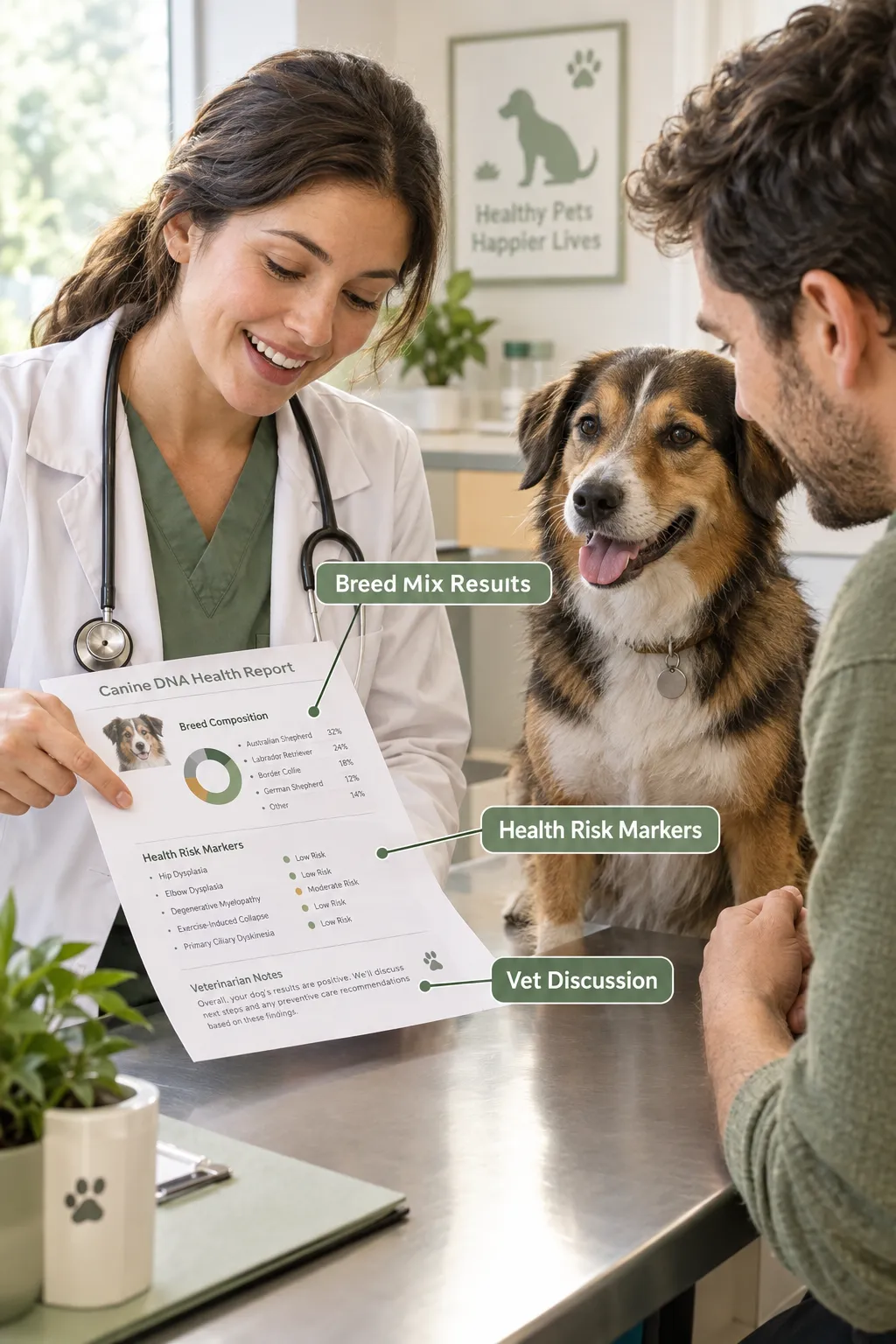
This is why two different test brands can give slightly different breed breakdowns for the same dog, each company’s database is proprietary and sized differently. Larger databases, like those used by Embark, cover over 350 breeds, types, and varieties, including village dogs and wolf ancestry markers in some panels [9][4]. Smaller or budget kits may only cover 100-200 breeds, which increases the chance that minor ancestry gets misclassified or lumped into a broader “mixed breed” category.
Example: a rescue dog that looks like a Labrador mix might return a breed report showing Labrador Retriever, American Pit Bull Terrier, and a trace of Chow Chow, a combination that wouldn’t be visually obvious.
Can Dog DNA Tests Detect Health Problems, and Do Vets Recommend Them?
Dog DNA tests can detect genetic markers linked to specific inherited conditions, such as certain eye diseases, drug sensitivities, and degenerative disorders, but they cannot diagnose current illness or guarantee a dog will never get sick. Many veterinarians support genetic testing as a useful screening tool, especially for breed-specific risk awareness, but they stress it should complement, not replace, regular veterinary exams [10][6].
Cornell University’s Riney Canine Health Center notes that DNA testing can help owners and breeders catch risk markers early, which supports more informed conversations with a veterinarian about monitoring or preventive care [10]. For dogs with breed-related orthopedic risk, for example, early awareness can shape decisions long before symptoms appear, which matters for conditions like the ones discussed in this guide to TPLO surgery in dogs. Owners should also keep up with core preventive care regardless of DNA results, including vaccination schedules outlined in this parvo vaccine guide for puppies.
Some newer panels introduced in September 2026 have expanded coverage of breed-specific disease markers, reflecting ongoing growth in the number of conditions labs can screen for as research catalogs more canine genetic variants [7].
Dog DNA Test vs. Breed Registry: What’s the Difference?
A dog DNA test estimates genetic breed ancestry through lab analysis, while a breed registry (like The Kennel Club) tracks documented pedigree lineage through paperwork and verified parentage. The two serve different purposes and aren’t interchangeable.
- DNA test: Works for any dog, including mixed breeds and rescues, and reports probable ancestry based on genetic markers.
- Breed registry: Requires documented lineage from registered parents and is used for pedigree certification, show eligibility, and breeding records [6].
A purebred dog with full registry papers can still take a DNA test, the results typically confirm the registered breed, though occasional surprises happen if there’s undocumented ancestry further back. A mixed-breed dog, by contrast, has no registry path but can still get a useful genetic snapshot through DNA testing.
Is a Dog DNA Test Worth It, Including Before Breeding?
A dog DNA test is worth it for most owners who want clarity on breed mix, health risk awareness, or relatedness data, and it becomes especially valuable before breeding, where it can flag inherited disease risks that affect puppy health. It’s less essential for owners who only want a diagnosis of a current symptom, since that still requires a vet visit.
Before breeding, testing both parent dogs can reveal:
- Shared recessive disease markers that could appear in puppies
- Unexpected ancestry that affects size or temperament expectations
- Relatedness that may be closer than assumed, raising inbreeding concerns
Genetic screening before breeding pairs well with broader whelping preparation, including awareness of risks like fading puppy syndrome, which can sometimes connect to inherited vulnerabilities. New owners preparing for puppies should also plan basics like crate setup well before the litter arrives.
Quick example: a breeder testing two dogs before mating discovers both carry a recessive marker for the same eye condition, prompting a different pairing decision to avoid passing the condition to offspring.
What Do You Do With a Dog DNA Test Sample, and What If Results Don’t Match Expectations?
Dog DNA test samples are collected at home with a cheek swab kit, then mailed to the company’s lab in a prepaid envelope or box for processing. If results don’t match what an owner expected, the explanation usually comes down to database limits, distant ancestry, or genuinely surprising but accurate heritage, not a lab error, though mistakes do occasionally happen.
Sample handling steps:
- Swab the inside of the cheek for the time listed in instructions (usually under a minute).
- Let the swab air-dry briefly if instructed.
- Seal it in the provided tube and mail it back promptly.
- Register the kit code online to link results to the correct profile.
If results seem off, say, a dog that looks like a Husky shows zero Husky ancestry, it’s worth checking three things first: whether the swab was taken correctly, whether the company’s database includes that specific breed line, and whether visual traits can be misleading since appearance and genetics don’t always align closely [1][2]. Owners who remain unsure can contact the company’s support team, and some offer re-testing options if a sample failed quality control. Curiosity about physical traits often extends beyond breed, too, some owners also look into questions like what colors dogs can actually see, which reflects genetics as well, though vision isn’t covered on standard breed panels.
Conclusion
A dog DNA test turns a cheek swab into a genetic snapshot: breed ancestry, relatedness, and, on fuller panels, inherited health risk markers, all generated through microarray scanning and database comparison. It’s a useful, increasingly affordable tool (roughly $60,$250, with results in 2-4 weeks), but it works best as one input alongside regular veterinary care, not a replacement for it.
Next steps:
- Decide whether breed curiosity or health screening matters more, then pick a kit database size accordingly.
- Follow swab instructions exactly to avoid delayed or inconclusive results.
- Bring any flagged health markers to a vet visit for context, not panic.
- If breeding is the goal, test both parent dogs well before planning a litter.
Frequently Asked Questions
What can a dog DNA test tell you?
A dog DNA test can tell you breed ancestry percentages, estimated relatives in the company’s database, predicted physical traits, and genetic health risk markers. It cannot diagnose a current illness or guarantee future health outcomes.
How accurate are dog DNA tests really?
Dog DNA tests are generally accurate for detecting primary breed ancestry already represented in a company’s reference database, but accuracy decreases for very small or distant ancestry percentages. No test offers 100% certainty on every result [1].
Best dog DNA test kits compared, which one should I choose?
Choose a larger-database kit like Embark or Wisdom Panel for complex mixed breeds needing detailed ancestry, or a budget breed-only kit like DNA My Dog if the goal is simple curiosity rather than health screening.
How much does a dog DNA test cost?
Most dog DNA tests cost between $60 and $250, with price rising alongside the depth of health screening included in the panel [2][5].
How long does it take to get dog DNA results?
Dog DNA results typically take 2 to 4 weeks from the time the lab receives the sample, though some companies process faster during low-volume periods.
Can dog DNA tests be wrong?
Yes, dog DNA tests can be wrong due to database gaps, sample quality issues, or close genetic similarity between related breeds, though major breed results are generally reliable.
Do vets recommend dog DNA tests?
Many veterinarians support DNA testing as a helpful screening tool for breed-related health awareness, but they recommend treating it as a supplement to regular veterinary exams, not a replacement [10].
Should I get my dog DNA tested before breeding?
Testing before breeding is strongly advised, since it can reveal shared recessive disease markers or close relatedness between potential breeding pairs that could affect puppy health.
What happens if my dog’s DNA results don’t match what I expected?
Mismatched results usually trace back to database limitations, distant or small-percentage ancestry, or misleading physical appearance rather than lab error, though contacting support for a review is reasonable if something seems clearly wrong.
Comparing Your Options
Quick decision guide: match your priority to a test type.
- Priority: Health screening → Pick a full panel kit (Embark, Wisdom Panel premium tiers).
- Priority: Budget → Pick a breed-only kit (DNA My Dog, Orivet basic).
- Priority: Breeding decisions → Pick the largest database kit available for both parent dogs.
References
[1] Dog Dna Test – https://www.livescience.com/dog-dna-test [2] Pet Dna Tests – https://www.chewy.com/education/cat/general/pet-dna-tests [3] How Do Dog Dna Tests Work – https://embarkvet.com/resources/how-do-dog-dna-tests-work/ [4] How It Works – https://embarkvet.com/pages/how-it-works [5] Dog Dna Test – https://www.petsmart.ca/learning-center/dog-care/dog-dna-test [6] Dna Testing – https://www.royalkennelclub.com/health-and-dog-care/health-dog-care/health/getting-started-with-health-testing-and-screening/dna-testing/ [7] New Dna Tests Updates September – https://www.combibreed.com/blog/new-dna-tests-updates-september/ [8] Embark Behavior Insights Dna Training – https://www.theunderbite.co/news/embark-behavior-insights-dna-training [9] How It Works – https://embarkvet.com/how-it-works/ [10] Benefits Canine Dna Testing – https://www.vet.cornell.edu/departments-centers-and-institutes/riney-canine-health-center/canine-health-topics/benefits-canine-dna-testing