

Quick Answer: IVDD in dogs stands for intervertebral disc disease, a condition where the cushioning discs between spinal bones bulge, slip, or rupture and press on the spinal cord. It causes pain, wobbly walking, or sudden paralysis, and it’s common in long-backed breeds like Dachshunds and Corgis. Treatment ranges from strict crate rest and medication to emergency spinal surgery, depending on severity.
Key Takeaways
- IVDD means intervertebral disc disease, damaged spinal discs pressing on the spinal cord or nerves [1].
- Early signs include reluctance to jump, a hunched back, yelping when touched, and wobbly back legs [7][8].
- Sudden hind-leg paralysis or loss of bladder control is a medical emergency; get to a vet within hours, not days [10].
- Dachshunds, Corgis, Beagles, Shih Tzus, and French Bulldogs are among the breeds most prone to IVDD [9][3].
- Mild cases (Grade 1-2) often respond to strict rest and medication; severe cases (Grade 4-5) usually need surgery [10][8].
- Surgery has a strong success rate when a dog can still feel pain in the affected limb before the operation [10].
- Recurrence is possible even after successful treatment, so long-term weight and activity management matter [2].
- Physical therapy and hydrotherapy speed recovery after both surgical and non-surgical treatment [8].
Table of Contents
What Is IVDD in Dogs?
IVDD in dogs stands for intervertebral disc disease, a disorder where the soft, cushion-like discs between the vertebrae lose their normal shape and press into the spinal canal [1][3]. This pressure can pinch nerves or bruise the spinal cord, causing pain, weakness, or paralysis depending on how severe the damage is.
Think of each disc as a jelly-filled shock absorber sitting between two spine bones. In a healthy dog, that disc flexes and cushions movement. In a dog with IVDD, the tough outer layer of the disc weakens and the inner gel either bulges (Hansen Type II) or ruptures suddenly (Hansen Type I), pushing material into the space where the spinal cord runs [4][6].
- Hansen Type I: Sudden disc rupture, common in small, long-backed breeds, often causing acute pain or paralysis [1][9].
- Hansen Type II: Gradual disc bulging, more common in larger breeds, causing slower, progressive weakness [6][9].
Quick example: A 6-year-old Dachshund that suddenly yelps and won’t climb stairs after a normal day of play is a classic Type I presentation, not a strain that will “walk off” on its own.
IVDD Symptoms in Dogs
The symptoms of IVDD in dogs range from subtle stiffness to sudden total paralysis, and the pattern depends on where along the spine the disc is affected and how much pressure is on the spinal cord [7][8]. Vets grade IVDD from 1 (mild pain only) to 5 (paralysis with no deep pain sensation), and the grade guides treatment decisions.
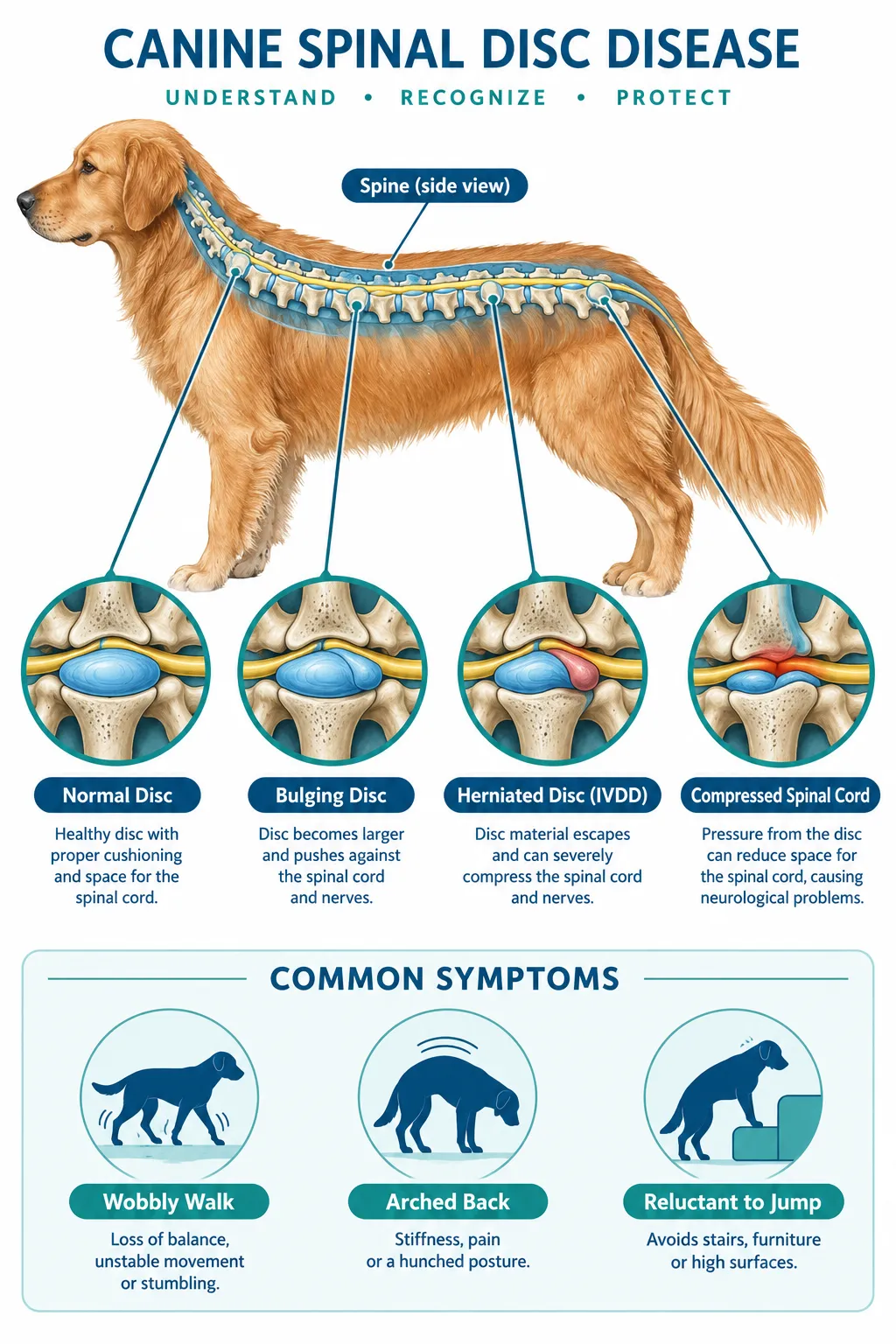
Common signs owners notice at home include:
- Reluctance to jump, climb stairs, or play like usual
- Arched or hunched back, or a “tucked” tail
- Yelping or snapping when picked up or touched near the spine
- Wobbly, uncoordinated back legs (often called a “drunken” gait)
- Dragging a paw so the top of the foot scuffs the ground
- Shaking or trembling, which can be a sign of spinal pain rather than cold or anxiety, our guide on why dogs shake covers other causes worth ruling out
- Loss of bladder or bowel control
Decision rule: If your dog shows mild stiffness but is still walking normally and using the bathroom fine, this is usually Grade 1-2, call your vet for an appointment. If your dog can’t stand, drags its legs, or stops controlling its bladder, this is Grade 3-5 and needs same-day emergency care.
IVDD Emergency Signs: When to Go to the Vet Right Away
IVDD becomes an emergency the moment a dog loses the ability to walk, feel pain in its back legs, or control its bladder, every hour of delay can lower the chances of a full recovery [10][8]. This is one of the few canine conditions where “wait and see” can cost permanent mobility.
Go straight to an emergency vet or veterinary neurologist if you see:
- Sudden inability to stand or walk on the back legs
- Dragging the back legs with no apparent limp, just loss of control
- Loss of deep pain sensation, pinching a toe gets no reaction at all
- Sudden incontinence paired with back pain or wobbliness
- Crying out when moved, with a rigid or hunched posture
Edge case: Some dogs with severe IVDD feel so much pain they go quiet and still instead of crying, owners sometimes mistake this for the dog “just being tired.” If a normally active dog suddenly refuses to move at all, treat it as an emergency, not fatigue. For comparison, other sudden neurological emergencies in young pets, like those covered in our guide on concussions in puppies, follow the same rule: fast neurological changes always warrant same-day vet attention.
What Causes IVDD in Dogs?
IVDD is caused by age-related or genetic degeneration of the spinal discs, which lose water content and elasticity over time until they bulge or rupture under normal daily stress [9][6]. In genetically predisposed breeds, this degeneration can start as early as 1-2 years old, long before symptoms appear.
Key contributing factors include:
- Genetics: Chondrodystrophic breeds (short legs, long backs) are born with discs that calcify and weaken earlier than average [9][3].
- Age: Disc material naturally dries out and stiffens with age, increasing rupture risk [6].
- Body weight: Extra weight adds mechanical stress on the spine [10].
- Repetitive strain: Jumping on and off furniture, rough play, or repeated stair use can trigger a rupture in an already weakened disc [4].
- Trauma: A fall or sudden twist can be the final trigger, even though the underlying disc damage built up over months or years [8].
Which Dog Breeds Are Prone to IVDD?
Dachshunds, Shih Tzus, Beagles, Corgis, French Bulldogs, and other short-legged, long-backed breeds carry the highest genetic risk for IVDD [9][3]. Large breeds like German Shepherds and Labradors can also develop the slower-progressing Type II form, usually later in life [6][9].
| Breed group | Typical IVDD type | Usual onset age |
|---|---|---|
| Dachshund, Corgi, Shih Tzu | Type I (sudden rupture) | 3-7 years |
| Beagle, French Bulldog, Pekingese | Type I (sudden rupture) | 4-8 years |
| German Shepherd, Labrador, Doberman | Type II (gradual bulge) | 6-10 years |
Common mistake: Assuming only “old” dogs get IVDD. Chondrodystrophic breeds can rupture a disc in their prime, often during normal play, because the degeneration starts in puppyhood even though symptoms show up later [9].
IVDD in Dogs Treatment: Surgery vs Conservative Care
IVDD in dogs treatment falls into two main paths, strict conservative (non-surgical) management for milder cases, and surgery for dogs with significant nerve damage or paralysis [10][8]. The right choice depends on the IVDD grade, how long symptoms have been present, and whether the dog still has deep pain sensation in the affected limb.
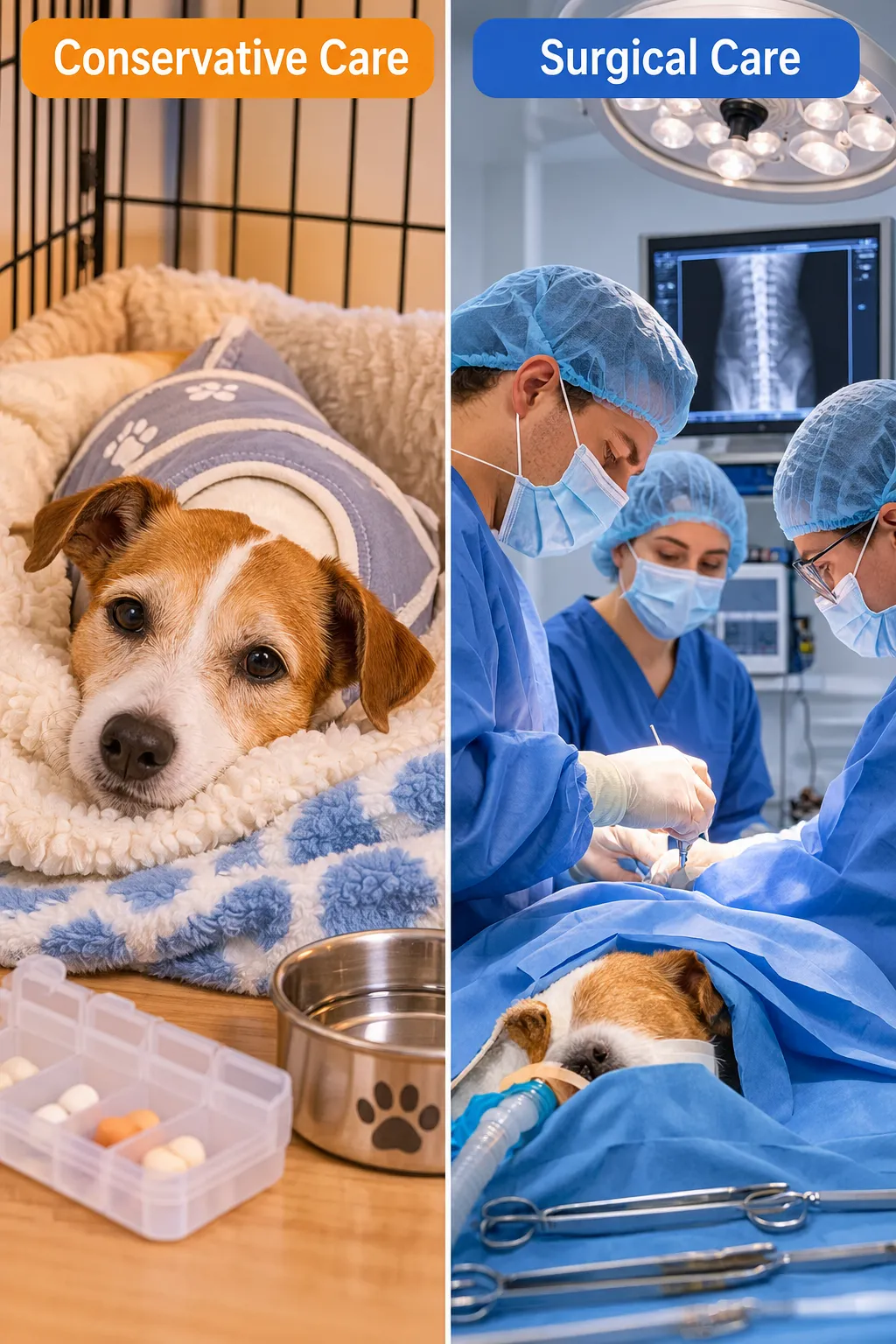
Conservative treatment typically includes:
- Strict crate rest for 4-6 weeks (this is non-negotiable, even short bursts of activity can worsen a bulging disc) [8]
- Anti-inflammatory medication or steroids, plus pain control [10]
- Muscle relaxants in some cases
Steroid or NSAID treatment can increase thirst and urination in some dogs, if you notice this, our article on why dogs drink more water than usual explains what’s a normal medication side effect versus a reason to call the vet.
Surgical treatment is usually recommended when:
- The dog has lost the ability to walk or feel pain (Grade 4-5) [10]
- Symptoms don’t improve, or worsen, after a few weeks of conservative care [8]
- Imaging (MRI or CT) confirms significant spinal cord compression [1]
Decision rule: Choose conservative management if your dog is Grade 1-2 (pain only, still walking), is a good candidate for strict rest, and your vet agrees imaging isn’t urgent. Choose surgery if your dog is Grade 3 or higher, especially if deep pain sensation is fading, waiting can close the window for a good outcome [10].
IVDD Surgery Cost for Dogs: How Much Should You Budget?
IVDD surgery for dogs typically costs between $3,000 and $8,000 in the United States, depending on the surgeon, imaging needed (MRI or CT), and aftercare [8][5]. This is a broad estimate, costs vary significantly by region and clinic, so always ask for a written quote before committing.
Costs generally include:
- Pre-surgical imaging (MRI/CT) to confirm the location and severity
- The surgical procedure itself (hemilaminectomy is common)
- Hospitalization and post-op monitoring
- Follow-up rehabilitation
For comparison, other specialized orthopedic procedures in dogs, such as TPLO surgery for torn ligaments, fall in a similar cost range, both are specialist procedures that justify getting quotes from a board-certified surgeon or neurologist rather than a general practice.
IVDD in Dogs Without Surgery: Is Recovery Possible?
Yes, many dogs with mild to moderate IVDD (Grade 1-3) recover well without surgery if owners follow strict crate rest and medication instructions exactly as prescribed [8][2]. Recovery without surgery is less reliable for dogs that have already lost deep pain sensation.
- Choose non-surgical management if: your dog is still walking (even wobbly), still has pain sensation, and you can commit to weeks of strict confinement.
- Common mistake: Letting a dog “test out” short walks once it seems a little better. Even a few days of early activity can cause a second, worse disc rupture [8].
Physical Therapy for Dogs With IVDD
Physical therapy helps dogs with IVDD rebuild strength, coordination, and muscle mass after both surgical and non-surgical treatment, and many specialists now consider it a standard part of recovery rather than an optional extra [8][2]. A rehab plan is usually built around the dog’s specific grade and surgical status.
Typical rehab tools include:
- Underwater treadmill or hydrotherapy, low-impact way to rebuild leg strength
- Passive range-of-motion exercises, gentle stretching for dogs with limited mobility
- Balance and proprioception exercises, wobble cushions, cavaletti poles
- Massage and laser therapy, used by some rehab vets to manage residual pain
Quick example: A Dachshund recovering from Grade 4 surgery might start with passive leg stretches in week one, move to supported standing by week three, and begin underwater treadmill sessions by week five, always on the surgeon’s timeline, not a generic schedule.
Can IVDD in Dogs Be Cured, or Is It Permanent?
IVDD itself, the underlying disc degeneration, isn’t “cured” in the sense of reversing it, but most dogs can regain normal or near-normal function with the right treatment and timing [2][10]. Whether symptoms resolve completely depends heavily on how quickly treatment started and how severe the nerve damage was.
- Mild cases (Grade 1-2): Often return to normal activity within weeks of rest and medication.
- Moderate to severe cases (Grade 3-4): Many regain walking ability, though some residual weakness or a changed gait can remain.
- Grade 5 (no pain sensation): Outcomes are far less predictable, and some dogs do not regain the ability to walk even with surgery [10].
Can a Dog Recover From IVDD Paralysis?
Yes, many dogs recover from IVDD-related paralysis, especially if they still have deep pain sensation at the time of treatment and receive surgery promptly [10]. Dogs that have completely lost pain sensation have a lower, though not zero, chance of walking again.
- Dogs with intact deep pain sensation: Surgical success rates for regaining the ability to walk are generally high [10].
- Dogs without deep pain sensation: Recovery is possible but less certain, and some dogs remain unable to walk unassisted, sometimes relying on a wheeled cart.
- Edge case: A small number of paralyzed dogs regain partial function weeks or even months later with aggressive rehab, so vets often recommend giving recovery a real chance before considering permanent mobility aids.
How Long Do Dogs Live After an IVDD Diagnosis?
An IVDD diagnosis on its own does not shorten a dog’s lifespan, most dogs live a normal lifespan with proper management, since IVDD affects mobility rather than internal organ function [2][9]. Life expectancy concerns usually relate to quality-of-life factors like chronic pain or recurring episodes, not the disc disease directly.
- Dogs that recover function (surgically or conservatively) typically go on to live full, active lives.
- Dogs with permanent paralysis can still live many comfortable years with cart support, bladder management, and regular vet checkups.
- Recurrence at a different spinal level is possible, so ongoing weight control and activity management matter long-term [2].
When to Consider Euthanasia for IVDD in Dogs
Euthanasia becomes a reasonable option for IVDD in dogs only when pain can’t be managed, paralysis is permanent with no response to treatment, and quality of life has seriously declined, it is not a default response to a difficult diagnosis [10]. This decision should always be made with your vet, not alone from fear of cost or inconvenience.
Questions to work through with your vet:
- Is the dog still eating, engaging, and showing interest in daily life?
- Is pain well-controlled with current medication?
- Has a reasonable trial of treatment (surgical or conservative) been given time to work?
- Are home-care needs (bladder expression, cart mobility, lifting) manageable for your household?
Common mistake: Making this decision in the first 48 hours of a paralysis episode. Many dogs show meaningful improvement over 2-6 weeks, so vets generally recommend a defined treatment trial before considering euthanasia, unless pain is uncontrollable.
How to Prevent IVDD in Dogs
You can’t fully prevent IVDD in genetically predisposed breeds, but you can lower the risk of a rupture and reduce severity by managing weight, limiting high-impact movement, and catching early signs fast [9][4]. Prevention is really about risk reduction, not guaranteed avoidance.
- Keep your dog at a healthy weight, extra pounds add spinal stress [10]
- Use ramps or steps instead of letting small dogs jump on and off furniture or beds
- Limit rough play and repetitive jumping, especially in chondrodystrophic breeds
- Support the back during handling, scoop under the chest and hindquarters rather than lifting under the belly alone
- Watch for early signs like stiffness or reluctance to jump, and call your vet early rather than waiting
Frequently Asked Questions
What does IVDD stand for in dogs? IVDD stands for intervertebral disc disease, a condition where the cushioning discs between spinal bones bulge or rupture and press on the spinal cord or nerves [1][3].
How do I know if my dog has IVDD? Watch for reluctance to jump, a hunched back, yelping when touched near the spine, wobbly back legs, or sudden paralysis, any of these warrants a vet visit, and sudden paralysis needs emergency care [7][8].
Which dog breeds are most prone to IVDD? Dachshunds, Corgis, Beagles, Shih Tzus, and French Bulldogs are among the highest-risk breeds due to their long backs and short legs [9][3].
Is IVDD in dogs curable? The underlying disc degeneration isn’t reversible, but most dogs regain good function with timely treatment, especially if caught before severe nerve damage occurs [2][10].
How much does IVDD surgery cost? IVDD surgery for dogs generally costs $3,000 to $8,000 in the U.S., depending on imaging, the surgeon, and aftercare needs [8][5].
Can a dog recover from IVDD without surgery? Yes, mild to moderate cases (Grade 1-3) often recover with strict crate rest and medication, though severe cases with lost pain sensation usually need surgery for the best chance of recovery [8][10].
How long do dogs live after an IVDD diagnosis? Most dogs live a normal lifespan after an IVDD diagnosis, since the condition affects mobility rather than organ health, as long as pain and mobility are managed well [2][9].
When should I consider euthanasia for a dog with IVDD? Only when pain can’t be controlled or paralysis is confirmed permanent after a reasonable treatment trial, this decision should be made with your vet’s guidance, not in the first days of diagnosis [10].
Conclusion
IVDD in dogs is a spinal disc condition that ranges from mild stiffness to sudden paralysis, and the outcome depends heavily on how fast you act. If your dog shows early signs like reluctance to jump or a hunched back, call your vet this week. If your dog suddenly can’t walk or loses bladder control, treat it as an emergency and go straight to an animal hospital, don’t wait to see if it passes.
Ask your vet directly about the IVDD grade, whether imaging is needed, and whether conservative care or surgery gives the better odds for your dog’s specific case. With the right timing and a committed recovery plan, most dogs with IVDD go on to live full, happy lives.
Related reading:- TPLO Surgery in Dogs: Cost, Recovery & What to Expect
- Why Is My Dog Shaking? Causes, Symptoms & When to Worry
- Can Puppies Get Concussions? Signs, Symptoms & Emergency Steps
- Why Is My Dog Drinking So Much Water? Causes & What to Do
References
[1] Intervertebral Disc Disease – https://www.vet.cornell.edu/departments-centers-and-institutes/riney-canine-health-center/canine-health-information/intervertebral-disc-disease [2] Intervertebral Disc Disease – https://www.vet.cornell.edu/departments-centers-and-institutes/riney-canine-health-center/canine-health-topics/intervertebral-disc-disease [3] Intervertebral Disk Disease Dogs – https://www.akc.org/expert-advice/health/intervertebral-disk-disease-dogs/ [4] Ivddslipped Disc In Dogs – https://www.pdsa.org.uk/pet-help-and-advice/pet-health-hub/conditions/ivddslipped-disc-in-dogs [5] Intervertebral Disc Disease Ivdd In Dogs – https://www.amcny.org/pet_health_library/intervertebral-disc-disease-ivdd-in-dogs/ [6] Diseased Spinal Disks – https://www.vet.cornell.edu/departments-centers-and-institutes/riney-canine-health-center/canine-health-topics/diseased-spinal-disks [7] What Is Intervertebral Disc Disease Dogs – https://www.webmd.com/pets/dogs/what-is-intervertebral-disc-disease-dogs [8] Intervertebral Disc Disease In Dogs – https://www.petmd.com/dog/conditions/neurological/intervertebral-disc-disease-in-dogs [9] Overview Of Intervertebral – https://www.akcchf.org/disease-history/overview-of-intervertebral/ [10] Intervertebral Disc Disease – https://www.acvs.org/small-animal/intervertebral-disc-disease/